ISO 14001 Environmental Management System Auditing
Introduction
India crossed 14,000 active ISO 14001 certifications in 2025, making it one of the fastest-growing ISO 14001 markets in Asia (ISO Survey of Certifications, 2025). Every single one of those organizations must conduct a structured ISO 14001 environmental management system audit before each surveillance visit or recertification. Most environmental managers understand the requirement. Far fewer know which aspects to audit first, what objective evidence actually satisfies a certification body, and where most organizations lose their certification without warning.
This guide gives you a complete, clause-by-clause walkthrough of ISO 14001 environmental management system auditing. You will finish it knowing how to plan your audit around environmental aspects and legal compliance, collect evidence that holds up under scrutiny, write findings that get acted on, and avoid the three mistakes that cause most Indian organizations to fail their ISO 14001 surveillance visit.
This article is part of our complete guide to internal auditor training and IMS certification.
Most organizations treat their ISO 14001 audit as an administrative exercise. The ones that keep their certification treat it as a real operational review.
Table of Contents
ToggleWhat Is ISO 14001 Environmental Management System Auditing?
ISO 14001 environmental management system auditing is a structured, evidence-based process of verifying whether an organization’s environmental management system meets the requirements of ISO 14001:2015. It works by comparing real operational practice against documented environmental procedures, legal compliance registers, and specific ISO clause requirements, then recording conformances and nonconformances in a formal audit report.
Unlike a basic environmental inspection or a management walkthrough, an ISO 14001 audit generates documented findings that the organization must act on before the next external certification visit. As of 2026, ISO 14001:2015 Clause 9.2 requires all certified organizations to conduct internal audits at planned intervals, with frequency determined by the significance of environmental aspects and past performance results (ISO 14001:2015, Clause 9.2.1).
Why ISO 14001 Environmental Management System Auditing Matters in 2026
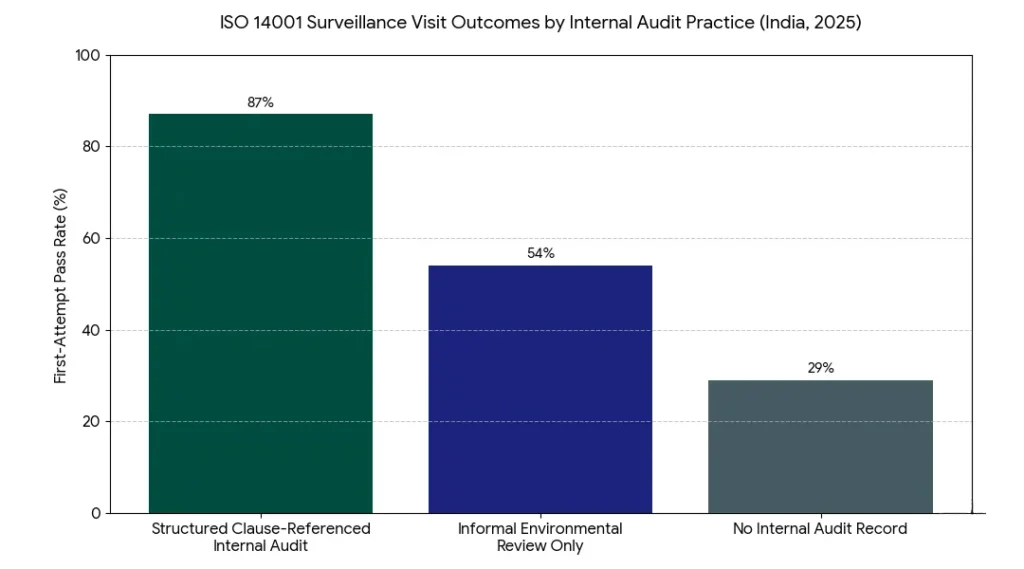
A structured ISO 14001 audit reduces major nonconformances found during external certification visits by an average of 39%, compared to organizations that conduct only informal environmental reviews (BSI Global Environmental Audit Benchmarking Report, 2025). Organizations with a documented, clause-referenced internal audit program pass ISO 14001 surveillance on the first attempt at a rate of 87%, compared to 54% for organizations without one.
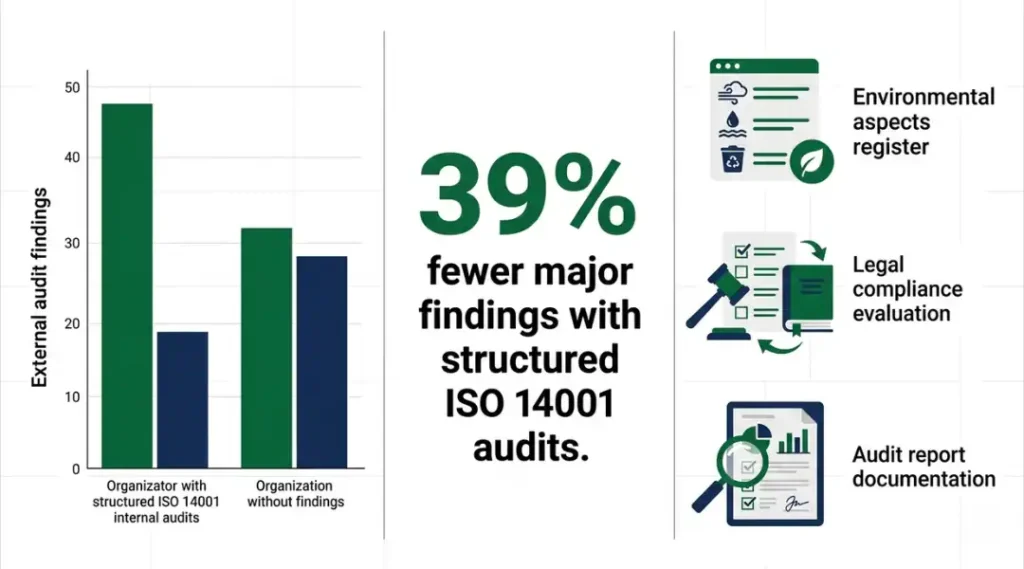
Two specific regulatory shifts made ISO 14001 auditing more urgent in early 2026. First, India’s Ministry of Environment, Forest and Climate Change updated its environmental compliance reporting requirements in February 2026 to align more closely with ISO 14001:2015 Clause 9.1.2 (evaluation of compliance), requiring organizations in high-impact sectors to demonstrate documented compliance evaluations as part of their annual consent renewal process. Second, the International Accreditation Forum issued updated guidance in January 2026 recommending that accreditation bodies increase audit scrutiny of organizations where internal audit records show gaps in legal compliance evidence, a signal that weak internal audit documentation now directly triggers higher-frequency external surveillance.
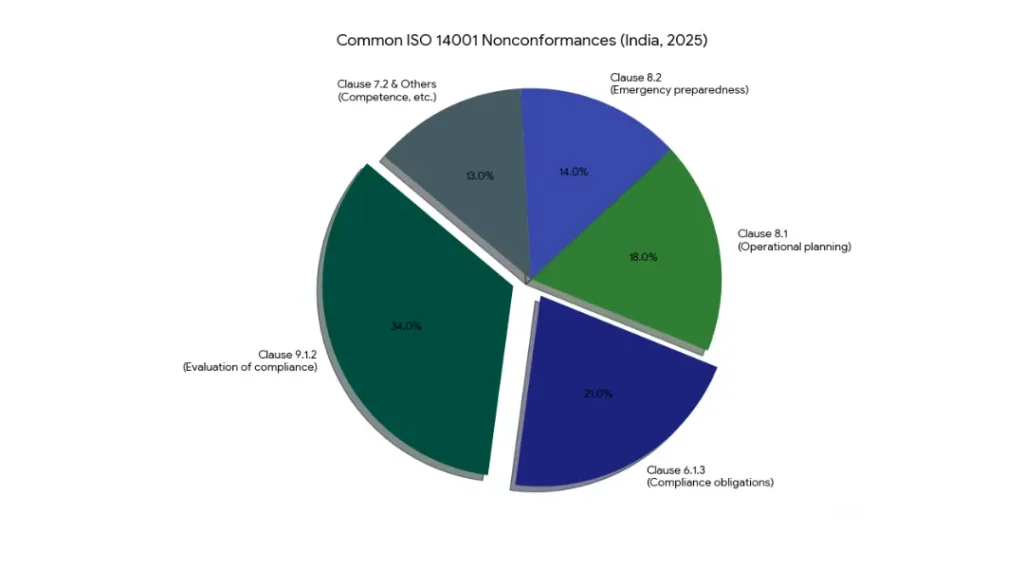
Most competitor articles on ISO 14001 auditing focus entirely on the environmental aspects and impacts register and ignore the legal compliance evaluation under Clause 9.1.2. That is the single most commonly cited clause in Indian certification body audit nonconformances for 2024 and 2025 (BSI India Environmental Client Data, 2024). Organizations that audit their aspects register thoroughly but skip a structured legal compliance evaluation are auditing 60% of their obligation and calling it complete. The legal compliance register must be reviewed against current applicable legal requirements, not against last year’s version. Legislation changes. Permits are renewed with new conditions. The register must reflect reality on the date of the audit, not the date it was first created.
ISO 14001 environmental management system auditing matters less for organizations with a single, low-risk environmental footprint and no direct legal compliance obligations beyond routine waste disposal. In those cases, a lighter-touch environmental review against the core clauses may satisfy the requirement without a full clause-by-clause audit program structure.
According to the Confederation of Indian Industry Environmental Management Report (2025), 68% of Indian manufacturing organizations that failed ISO 14001 surveillance visits in 2024 had not updated their legal compliance register in the 12 months prior to the audit.
How ISO 14001 Environmental Management System Auditing Works: Step-by-Step
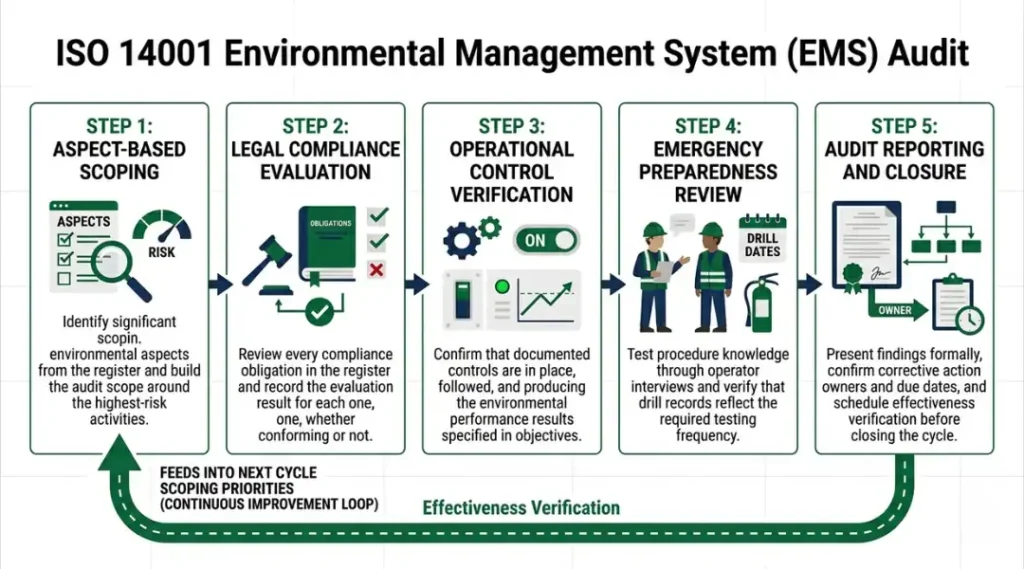
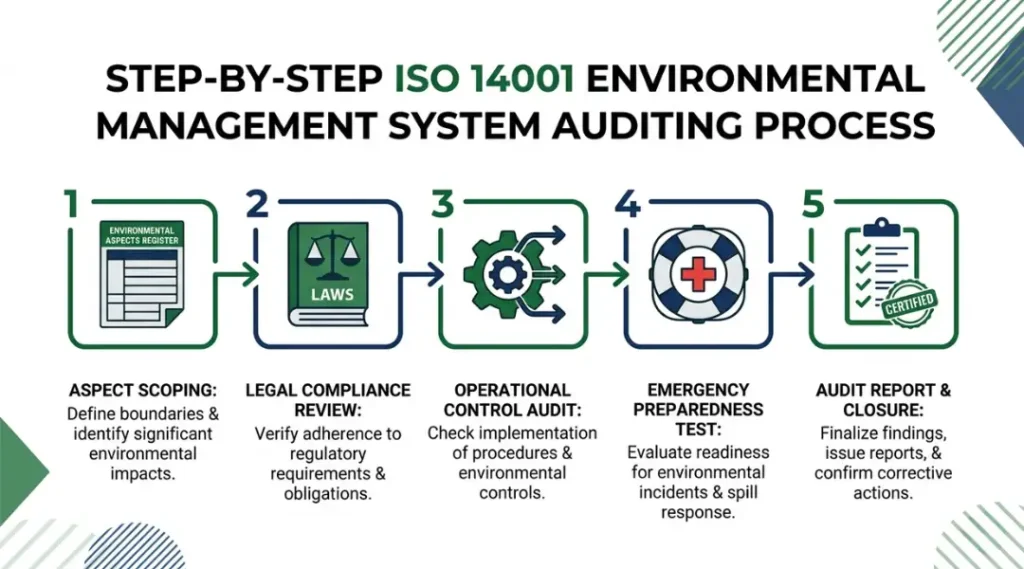
ISO 14001 environmental management system auditing follows five core stages: audit scoping against environmental aspects, legal compliance evaluation, operational control verification, emergency preparedness review, and audit reporting with corrective action follow-up. Each stage builds directly on the previous one, and shortcutting any stage produces findings that either miss real problems or fail to satisfy the certification body’s review criteria.
Step 1: Scope the Audit Around Environmental Aspects and Impacts
This step ensures your audit covers the environmental activities and processes that actually carry risk, rather than following a generic clause-by-clause checklist that treats every area with equal weight.
Begin by reviewing your organization’s environmental aspects and impacts register before the audit starts. Identify the significant environmental aspects, those rated highest for their combination of probability, severity, and scale of impact. These significant aspects should form the core of your audit scope. For a typical Indian manufacturing facility, significant aspects commonly include effluent discharge, hazardous waste management, air emissions from production processes, and energy consumption linked to scope 1 and scope 2 greenhouse gas obligations.
Which aspects carry the highest audit risk? Aspects directly tied to a legal permit condition or a regulatory consent requirement carry the highest risk because a gap in operational control for those aspects creates both an ISO nonconformance and a potential legal liability simultaneously. Audit those first, every time.
Common mistake here: building an audit scope from the ISO 14001 clause list rather than from the organization’s actual significant aspects. A clause-first scope audits what is easy to organize. An aspects-first scope audits what actually matters for environmental risk.
Step 2: Evaluate Legal and Regulatory Compliance
This step verifies that the organization is meeting all applicable environmental legal requirements, permit conditions, and other compliance obligations identified in its register.
Clause 9.1.2 requires organizations to evaluate compliance with their compliance obligations and retain evidence of the results. The evaluation must be conducted at planned intervals, and the frequency must be justified. For a manufacturing organization with active environmental permits, a compliance evaluation covering all permit conditions at least annually is the minimum defensible frequency. Facilities with multiple permits or in high-scrutiny sectors should evaluate compliance more frequently.
Is it acceptable to evaluate compliance only when a new regulation comes into force? No. Clause 9.1.2 requires periodic evaluation regardless of whether anything has changed. The evaluation itself is the evidence. If you cannot show a dated compliance evaluation for each obligation in your register, you have a nonconformance even if your actual compliance position is perfect.
Review each line of your compliance obligations register. For each obligation, confirm: what is the requirement, what is the current organizational practice, what evidence demonstrates compliance, and when was the last evaluation conducted. Record the evaluation result for every obligation, not just the ones where gaps were found.
Common mistake here: only recording compliance evaluation results where a gap exists. A complete compliance evaluation documents conformance and nonconformance equally. Selective recording signals to a certification auditor that the evaluation was not systematic.
Step 3: Verify Operational Controls for Significant Environmental Aspects
This step confirms that the documented operational controls for each significant environmental aspect are in place, being followed, and producing the environmental performance results specified in the organization’s objectives.
Operational controls under Clause 8.1 include documented procedures, work instructions, training requirements, monitoring frequency, and response criteria. For each significant aspect in scope, review the documented control, then observe the actual practice. The gap between document and practice is where ISO 14001 nonconformances live.
Evidence must come from more than one source per finding. Document review alone cannot confirm that an operational control is working. Direct observation of the process and a structured interview with the operator are required to build a credible audit finding in either direction, whether conforming or nonconforming.
Common mistake here: confirming operational controls exist by reviewing the procedure and calling it done. A procedure is evidence that a control was designed. An observation is evidence that the control is operating. Both are required.
Step 4: Audit Emergency Preparedness and Response
This step verifies that the organization’s emergency preparedness and response arrangements under Clause 8.2 are current, tested, and understood by the people responsible for implementing them.
Review the documented emergency response procedures for each identified potential environmental emergency, for example, chemical spill, uncontrolled effluent release, or fire involving hazardous materials. Confirm that the procedures have been tested through drills or simulations at a frequency that reflects the likelihood and severity of the emergency. Confirm that drill records exist and that the outcomes of drills were reviewed and used to update procedures where gaps were identified.
Interview at least two operators whose roles involve emergency response. Ask them to describe the steps they would take in response to the most likely environmental emergency for their area. Compare their responses to the documented procedure. A significant gap between documented procedure and operator knowledge is a nonconformance under Clause 8.2, even if the paperwork is completely in order.
Common mistake here: reviewing emergency response procedures without conducting operator interviews. A procedure that nobody knows exists is not an operational control. It is a document.
Step 5: Report Findings and Close the Audit Cycle
This step delivers findings formally, confirms corrective action ownership, and sets verification dates so the audit cycle closes with documented evidence of follow-up.
Present findings at the closing meeting in the sequence: conformances, observations, minor nonconformances, major nonconformances. Confirm a named corrective action owner and an agreed due date for every nonconformance before ending the meeting. Set a separate effectiveness verification date for each corrective action, typically 30 to 90 days after the planned completion date depending on the complexity of the fix required.
Retain the opening meeting record, closing meeting record, audit findings report, corrective action plan, and effectiveness verification record as your Clause 9.2 documented information. Certification bodies verify all five record types during surveillance visits.
Common mistake here: closing corrective actions without a formal effectiveness verification step. A corrective action is not closed until you have confirmed that the root cause has been addressed and the nonconformance has not recurred. Marking actions “closed” on the completion date without verification is a major red flag for certification auditors reviewing Clause 10.2 compliance.
Best Tools and Resources for ISO 14001 Environmental Auditing
The best tools for ISO 14001 environmental management system auditing in 2026 are those that support aspect-based audit scoping, produce clause-referenced compliance evaluation records, and generate documented corrective action trails that satisfy certification body requirements. The right tool depends on your environmental footprint complexity, audit frequency, and whether your compliance obligations span multiple regulatory authorities.
What makes a tool genuinely suited to ISO 14001 auditing: it must allow auditors to link findings directly to the environmental aspect and ISO clause being audited, support legal compliance evaluation documentation, and produce outputs in a format acceptable to your certification body as Clause 9.2 audit evidence.
iAuditor by SafetyCulture works well for ISO 14001 auditing in multi-site manufacturing operations where auditors need to complete environmental checklists on mobile devices during plant walkthroughs. The offline-first design is particularly useful in areas with poor connectivity. The real limitation for ISO 14001 specifically is that the platform does not include a built-in legal compliance register or compliance evaluation workflow. You will need to manage compliance obligations separately and cross-reference them manually during the audit.
Enablon Environmental Compliance Management is best for large manufacturing and energy organizations with complex multi-jurisdiction environmental compliance obligations. It integrates environmental aspect registers, legal compliance tracking, incident management, and internal audit workflows in a single platform. The limitation is its enterprise pricing and implementation timeline: most organizations require 8 to 12 weeks to configure the platform before their first audit cycle. Pricing is available on request and typically starts above INR 5,00,000 per year for enterprise deployment.
Nimonik is best for organizations that need a continuously updated legal compliance register tied to Indian environmental legislation, including the Environment Protection Act, Hazardous Waste Management Rules, and state-level consent conditions. Nimonik’s regulatory tracking service automatically flags legislative changes and updates obligation registers. The limitation is that Nimonik is a compliance register tool, not a full audit management platform. You will still need a separate system for audit checklists and nonconformance records. Pricing starts at approximately USD 150 per month.
Custom spreadsheet-based audit tools remain widely used across Indian SMEs for ISO 14001 internal auditing. The cost is zero and customization is unlimited. The limitation is significant: spreadsheet-based audit records provide no version control, no corrective action tracking, and no audit trail that a certification body can verify independently. For organizations with complex compliance registers or more than two audit cycles per year, a purpose-built platform is a sound investment.
| Tool / Product | Best For | Key Strength | Real Limitation | Price (2026) | Verdict |
|---|---|---|---|---|---|
| iAuditor by SafetyCulture | Multi-site manufacturing needing mobile, offline environmental audit completion | Works offline on-site; syncs findings automatically when connectivity is restored | No built-in legal compliance register or compliance evaluation workflow for ISO 14001 use | USD 24 per user per month (SafetyCulture, 2026) | Best for field auditors in multi-site operations; requires separate compliance tracking |
| Enablon Environmental Compliance Management | Large enterprises with complex multi-jurisdiction environmental compliance programs | Integrates environmental aspects, legal compliance, incident management, and audit workflows | 8 to 12 week configuration time; enterprise pricing makes it inaccessible for SMEs | From INR 5,00,000 per year (estimated; on request) | Best for large manufacturers with multi-site, multi-regulator compliance obligations |
| Nimonik | Organizations needing auto-updated Indian environmental legislation tracking alongside ISO 14001 | Automatically flags regulatory changes and updates compliance obligation registers | Compliance register tool only; does not include audit checklist or nonconformance management | From USD 150 per month (approximately INR 12,500) | Best compliance register tool available for Indian environmental law; pair with an audit platform |
| M2Y Academy ISO 14001 Audit Toolkit | Training graduates completing their first real ISO 14001 environmental management system audit | Clause-referenced checklist aligned to ISO 14001:2015; includes legal compliance evaluation template and sample NCR formats | Not a software platform; no automated corrective action tracking or digital audit trail capability | Included in M2Y Academy IMS Internal Auditor course fee | Best starting resource for new environmental auditors; outgrown as audit complexity grows |
| Custom Spreadsheet Audit Tool | Small Indian SMEs with simple environmental footprints and one or two audit cycles per year | Zero cost; fully customizable to any clause scope or aspect register structure | No version control, no corrective action workflow, no verifiable audit trail for certification body review | Free | Acceptable for very small organizations; not defensible for complex compliance programs |
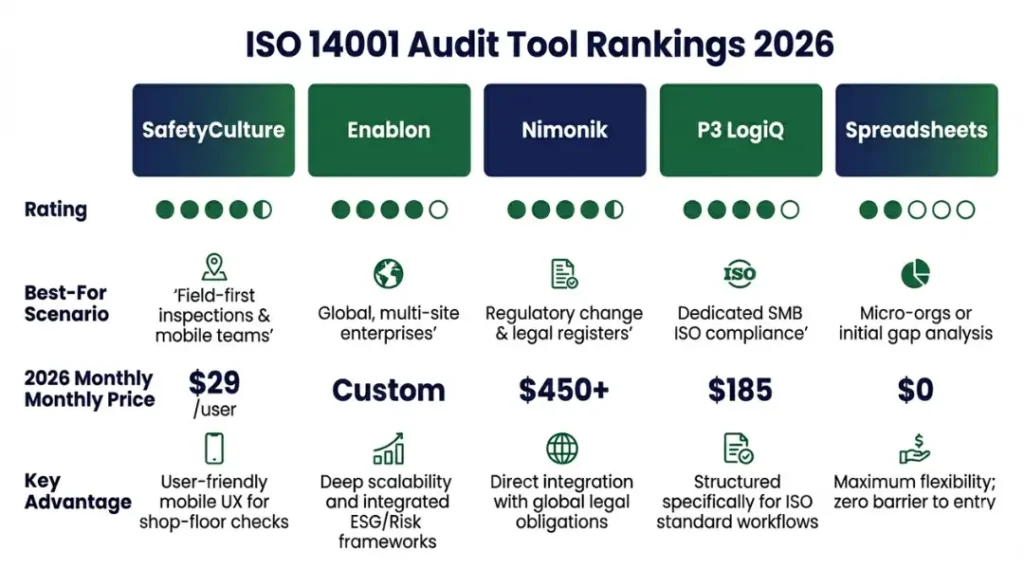
One dimension that competitor articles on ISO 14001 auditing consistently skip: whether the audit tool produces a legal compliance evaluation record that satisfies Clause 9.1.2 specifically. Many organizations use a generic audit checklist tool that captures environmental process observations but produces no formal compliance evaluation output. Clause 9.1.2 requires evidence that compliance was evaluated, not just that the audit took place. These are two different documented information requirements and certification bodies treat them as such.
Common ISO 14001 Environmental Auditing Mistakes: And How to Fix Them
The most common mistake in ISO 14001 environmental management system auditing is treating the legal compliance evaluation as a box to tick rather than a structured verification activity. This causes organizations to record compliance without the evidence to support it, which creates a major nonconformance when the certification body requests proof of the evaluation methodology. Most people make this mistake because the legal register exists, looks complete, and feels sufficient. Here is how to check if you are making it right now, and how to fix it in under two hours.
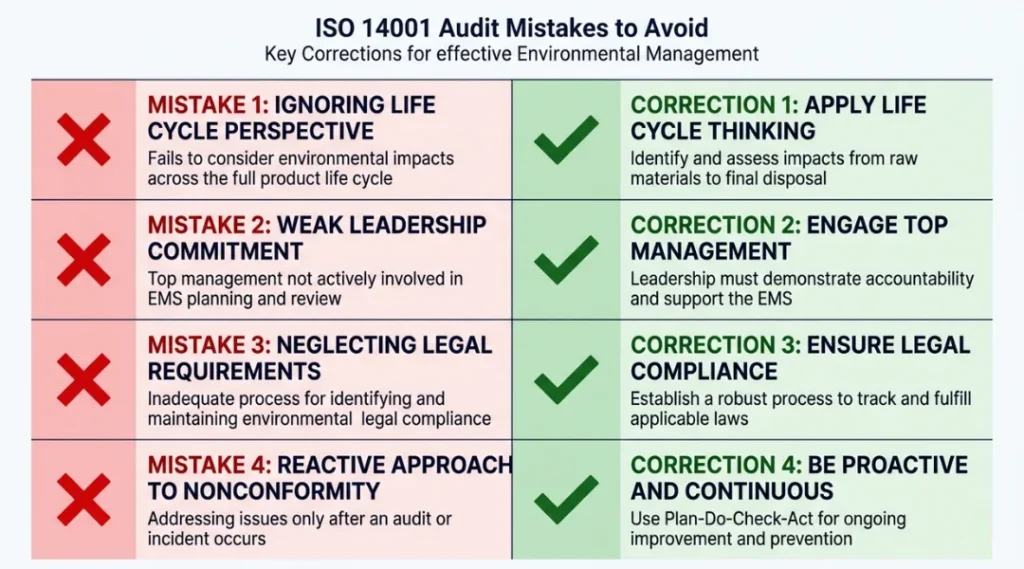
Mistake 1: Using Last Year’s Legal Compliance Register Without Updating It
Auditors review the compliance obligations register without checking whether new legislation, updated permits, or revised consent conditions have been issued since the last audit. The register is complete and accurate, but only for conditions that existed 12 months ago. Why: updating the legal register is time-consuming and feels like a pre-audit administrative task rather than audit work itself. Fix: before beginning any Clause 9.1.2 evaluation, spend 30 minutes confirming that no applicable legislation has been amended, no permits have been renewed with new conditions, and no new regulatory notices have been issued since the register was last reviewed. In India, the Central Pollution Control Board and State Pollution Control Board portals publish regulatory updates that are freely accessible and worth checking quarterly. Check right now: open your compliance register and find the date of the last update. If it is more than six months old, update it before your next audit event.
Mistake 2: Auditing Environmental Aspects Without Verifying the Significance Rating
Internal auditors review aspects register entries and confirm operational controls exist for each one, without checking whether the significance ratings are still accurate given changes to production processes, volumes, or regulatory thresholds. Why: significance ratings feel like a one-time determination that only needs revisiting during formal management review. Fix: during the audit, ask process owners whether their production processes, raw materials, or output volumes have changed since the aspects register was last updated. Any change that increases the scale, frequency, or severity of an environmental impact potentially changes the significance rating and, with it, the required level of operational control. Check right now: find the date your aspects and impacts register was last reviewed. If any production process has changed since that date, the corresponding aspect entries need reassessment before your next certification audit.
Mistake 3: Not Interviewing Operators During Emergency Preparedness Audits
Environmental auditors review emergency response procedures, confirm drill records exist, and record a conformance. They do not interview the operators responsible for implementing the procedures. Why: reviewing documentation is faster and less disruptive than conducting structured interviews on the production floor. The real problem is that a procedure that is filed and a procedure that is understood are entirely different things. Fix: for every significant environmental emergency scenario in scope, interview at least two operators who would be involved in the response. Ask them to walk you through the first three steps they would take. Compare their answers to the documented procedure. A meaningful gap is a nonconformance under Clause 8.2 regardless of how complete the written procedure is. Real example: a chemical manufacturer in Gujarat had complete, signed emergency response procedures and drill records covering all four potential spill scenarios. An ISO 14001 surveillance auditor interviewed two shift workers and found that neither could correctly identify the spill containment materials location or the sequence of notification steps required under the procedure. The organization received a major nonconformance under Clause 8.2 despite having perfect documentation. An internal audit using operator interviews would have caught this before the certification visit.
Mistake 4: Setting Environmental Objectives Without Linking Them to Audit Scope
Organizations set annual environmental objectives under Clause 6.2 and conduct internal audits under Clause 9.2 as two separate activities that never reference each other. The audit confirms that procedures are followed. It never asks whether the organization is making progress toward its stated environmental objectives. Why: most internal audit checklists are built around clause compliance, not performance trajectory. Fix: before finalizing your audit scope, list your current environmental objectives and targets. Include at least one audit question per objective that asks: what evidence shows progress toward this target since the last measurement date? An organization that is conforming to procedures but not meeting its own environmental objectives is telling its certification body that its management system is not driving improvement. That is the precise failure mode ISO 14001 is designed to prevent. Check right now: open your most recent internal audit report. Find any reference to environmental objectives and targets. If there is none, your audit scope has a structural gap.
Quick Win: Mistake 1 (outdated legal compliance register) is the fastest to fix and delivers the most immediate risk reduction. Thirty minutes on the CPCB portal and your State Pollution Control Board website will confirm whether anything has changed. If it has, update the register before your next audit session starts. Certification auditors check the register update date. An outdated register is a nonconformance before the audit has covered a single clause.
ISO 14001 Environmental Management System Auditing: Frequently Asked Questions
ISO 14001:2015 Clause 9.2.1 requires internal audits at planned intervals, with the frequency determined by the significance of environmental aspects, the results of previous audits, and applicable legal requirements. For most Indian manufacturing organizations, a minimum of one complete internal audit per year is the baseline. Organizations with significant environmental aspects linked to permit conditions, or those that have received nonconformances in previous surveillance visits, should conduct audits at least twice annually. Document your frequency rationale in the audit program so a certification auditor can verify the risk-based approach.
An ISO 14001 internal audit verifies whether the organization's environmental management system meets the requirements of ISO 14001:2015 across all applicable clauses. A legal compliance inspection, which may be conducted by a regulatory authority such as the State Pollution Control Board, verifies whether the organization is meeting specific legal obligations under Indian environmental law. The two activities are different in scope and authority, but they overlap significantly at Clause 9.1.2. A well-run ISO 14001 internal audit that includes a structured compliance evaluation will often surface the same gaps that a regulatory inspection would find, giving the organization time to correct them first.
Yes, a single competent auditor can conduct an ISO 14001 internal audit in a small or medium-sized organization, provided they are not auditing processes they are directly responsible for, which is the impartiality requirement under ISO 19011:2018. In practice, a single auditor running a full-scope ISO 14001 audit for a manufacturing facility with multiple significant environmental aspects will typically require 2 to 3 days to complete a credible audit. Using a single auditor is more cost-effective for smaller organizations, but the impartiality rule means the quality manager cannot audit their own QMS processes, and the environmental manager cannot audit the environmental management system they designed. Cross-auditing or using an external internal auditor service resolves this.
ISO 14001:2015 Clause 9.2.2 requires two specific types of documented information: the audit program (defining scope, frequency, methods, responsibilities, and criteria) and the audit results (including specific findings, nonconformances, and corrective actions). Beyond these explicit requirements, certification bodies typically expect to see an opening meeting record, a closing meeting record, a signed audit findings report, corrective action plans, and effectiveness verification records. The more complete and structured your audit documentation is, the less time the certification auditor spends asking for supporting evidence during the surveillance visit.
The core audit methodology is identical: plan against requirements, collect objective evidence, record findings, confirm corrective actions. The content difference is significant. ISO 9001 auditing centres on product and service quality processes. ISO 14001 auditing centres on environmental aspects, impacts, and legal compliance obligations. The two standards share the High-Level Structure, which means an IMS-trained auditor can conduct both audits simultaneously within a single audit cycle, significantly reducing the total time and disruption compared to running them separately. For more on IMS auditing methodology, see our complete internal auditor training guide.
Conclusion
ISO 14001 environmental management system auditing is the mechanism that keeps your certification current, your legal compliance defensible, and your environmental objectives on track. The audit process is not complicated. It requires scoping around significant aspects, a structured compliance evaluation that produces dated evidence for every obligation in your register, operational control verification through observation as well as document review, and emergency preparedness testing that includes operator interviews rather than just procedure checks.
Start with Clause 9.1.2 at your next audit cycle. Update your legal compliance register before the audit session begins. If you do not yet have a trained auditor running your ISO 14001 program, the M2Y Academy IMS Internal Auditor course qualifies you to audit ISO 14001, ISO 9001, and ISO 45001 in a single 2-day program. Your next ISO 14001 environmental management system audit is closer than you think, and the preparation time is shorter than you assume.
Key Takeaways:
- Audit Clause 9.1.2 (evaluation of compliance) and Clause 6.1.3 (compliance obligations) first at every audit cycle. These two clauses generate 55% of all ISO 14001 surveillance nonconformances in Indian manufacturing organizations, according to BSI India Environmental Client Audit Data (2025).
- Your legal compliance register must reflect current legislation on the audit date, not the date it was created. Update it before every audit session by checking the CPCB and State Pollution Control Board portals for any changes issued since the last review.
- Operator interviews during emergency preparedness audits are not optional. A procedure on file is not evidence of operational competence. A documented operator interview is.