NEBOSH Courses
Key Takeaways
- NEBOSH IGC (International General Certificate) is the fastest route to a globally recognised HSE qualification: most candidates complete it in 3 months with 150–200 hours of guided study.
- India now produces more NEBOSH candidates annually than any other country outside the UK, yet fewer than 1 in 3 candidates pass the NG1 written paper on their first attempt. Choosing the right provider is not optional.
- NEBOSH course fees in India range from ₹25,000 to ₹95,000 depending on the qualification and delivery format; online open-book format costs significantly less than classroom.
- The single biggest mistake candidates make is choosing a course based on price alone. Providers with low pass rates are often cheaper upfront but far more expensive after a resit.
Table of Contents
Toggle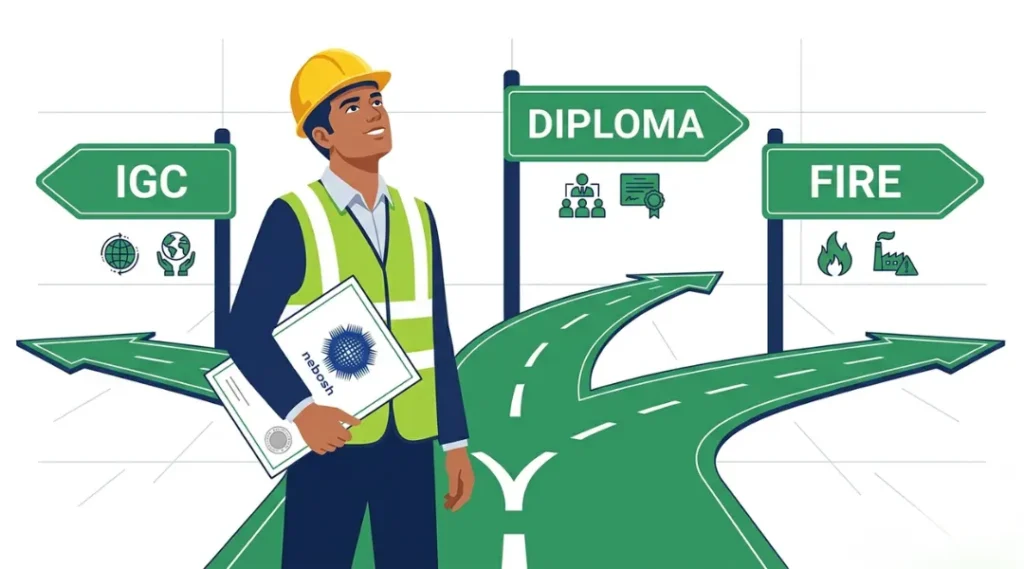
What Are NEBOSH Courses?
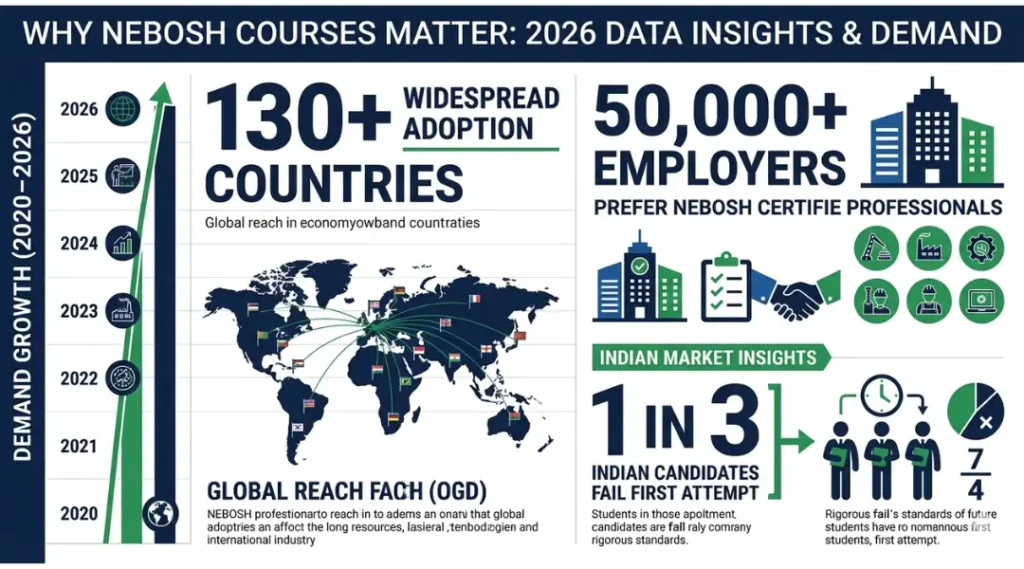
NEBOSH courses are internationally recognised health and safety qualifications awarded by the National Examination Board in Occupational Safety and Health, a UK-based examining body founded in 1979. Each qualification tests your ability to identify workplace hazards, control risks, and respond to incidents. Unlike short safety awareness programmes, NEBOSH certifications require written examinations and a practical assessment, which is why employers in over 130 countries treat them as the baseline for serious HSE roles. As of 2026, more than 50,000 organisations globally require or prefer NEBOSH-qualified staff (NEBOSH Annual Report, 2025).
Why NEBOSH Courses Matter in 2026
NEBOSH qualifications are no longer just a résumé addition; they are the minimum hiring requirement at most reputable HSE employers in India, the Gulf, and the UK. The job market shifted hard after 2022. Many oil and gas, construction, and logistics companies moved from “preferred” to “mandatory” NEBOSH status for site safety officers. Employers stopped shortlisting unqualified candidates regardless of experience.
Two specific changes in the last 12 months made this even more urgent. In January 2026, the Saudi Arabia General Authority for Statistics updated contractor HSE requirements for Vision 2030 projects: NEBOSH IGC or equivalent is now explicitly listed as a minimum credential for HSE supervisors on mega-projects. In March 2026, NEBOSH released its updated Open Book Examination (OBE) framework for the IGC, extending the scenario-complexity level, a change that has already affected pass rates in the first two sittings of the year.
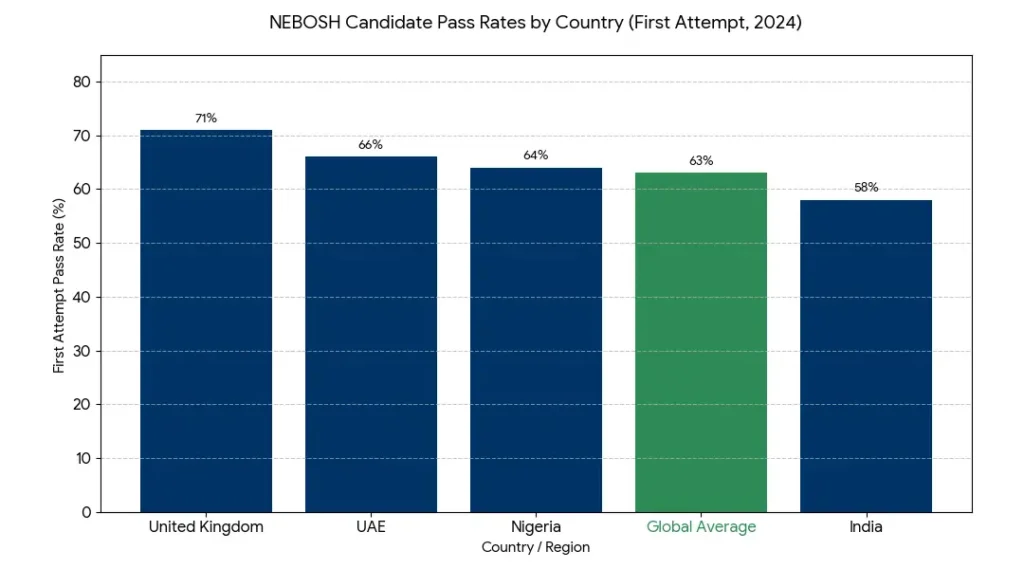
India now accounts for roughly one-third of all NEBOSH candidates globally outside the UK (NEBOSH Global Statistics Report, 2025). Yet pass rates for Indian candidates on the NG1 written unit remain lower than the global average: approximately 58% first-attempt pass rate versus the global 63% (NEBOSH Examiner Report, Unit NG1, 2024). The gap is almost entirely explained by tuition quality, not candidate ability.
What most competitor articles miss: the real value of NEBOSH is not the certificate on your wall. It is the shift in how you think about risk. Candidates who study properly, not just pass, become the people organisations trust to handle incidents, audits, and regulatory inspections. That is the career value no one prices into a comparison table.
When does NEBOSH matter less? If your employer operates only in a domestic Indian context with no international contracts and no Gulf exposure, an IOSH Managing Safely certificate or a DGFASLI certification may be sufficient and significantly cheaper. NEBOSH is most valuable where international recognition is a genuine requirement, not just an aspiration.
How NEBOSH Courses Work: Step-by-Step
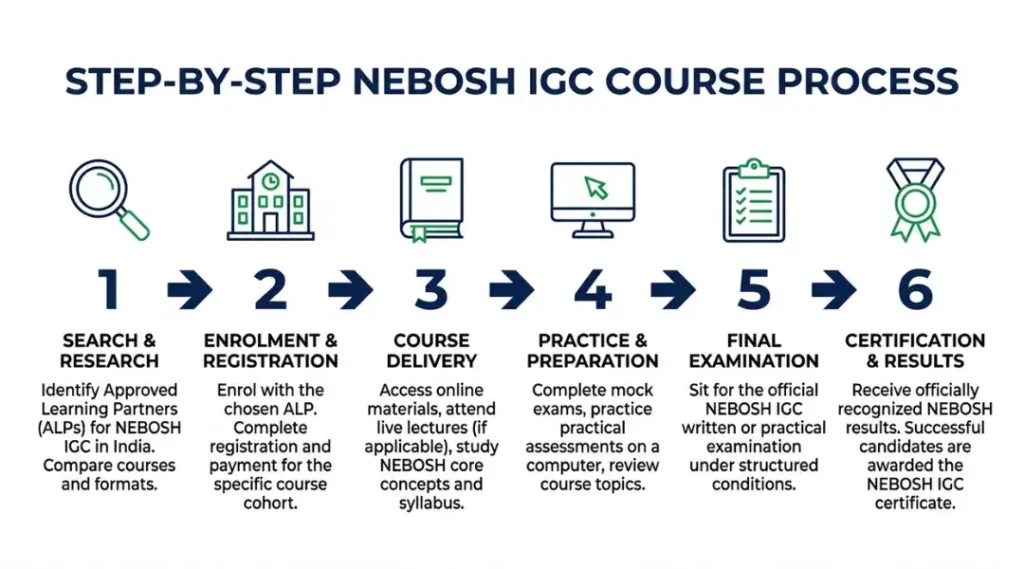
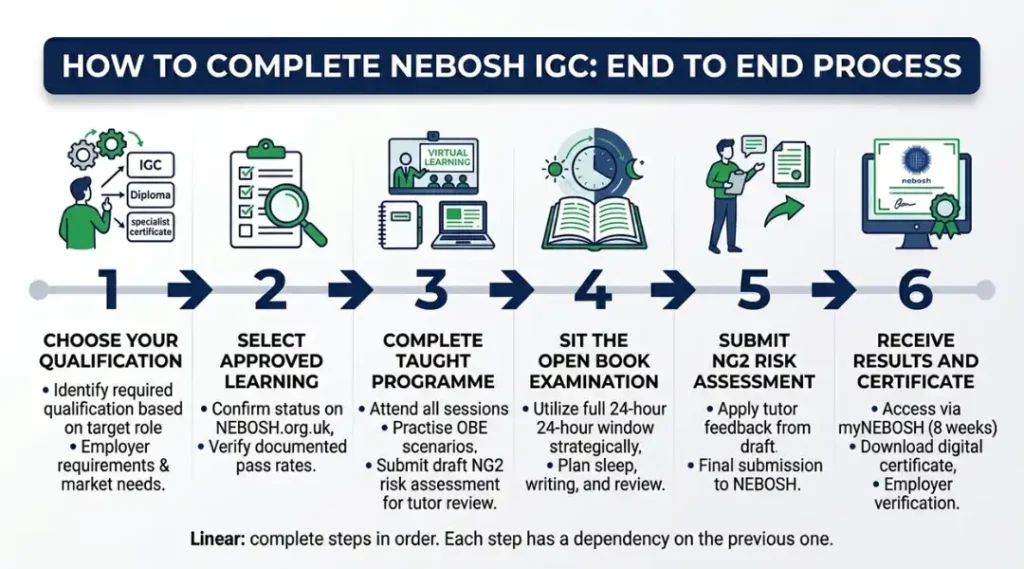
NEBOSH courses follow a fixed structure: enrol with an approved Learning Partner, complete a taught programme, sit a written examination (open-book for IGC), then complete a practical assessment, all administered under NEBOSH’s direct oversight. The full IGC cycle takes 10–16 weeks for most working professionals. Skipping any stage is not possible. NEBOSH controls every element from registration to results.
Step 1: Choose the Right NEBOSH Qualification
Your industry and career goal determine which course you need, not price or duration.
NEBOSH offers nine active qualifications. The IGC (International General Certificate) suits most safety officers and supervisors across industries. The NEBOSH Diploma is for experienced practitioners who want senior or consultancy roles. The NEBOSH Fire Certificate targets fire safety specialists in hospitality, facilities, and manufacturing.
If your goal is a Gulf or international site role, start with IGC. If you are already qualified and want to move into management or consultancy, the Diploma is the correct next step.
Common mistake here: enrolling in the National General Certificate (NGC) when you need the International General Certificate (IGC). The NGC is UK-specific. Employers in India, UAE, and Saudi Arabia require the IGC. They are not equivalent for international job applications.
Step 2: Select an Approved Learning Partner
NEBOSH does not deliver training directly. Every candidate must enrol through a NEBOSH-approved Learning Partner.
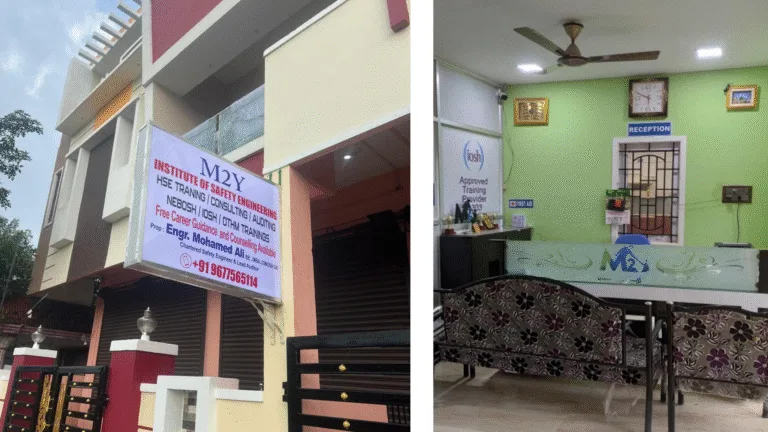
Approved Learning Partners are audited by NEBOSH against a set of quality criteria: tutor credentials, learning materials, student support, and historical pass rates. M2Y Global Academy is an approved NEBOSH Learning Partner with centres in India and the UAE.
Check the NEBOSH website directly to confirm your provider’s approval status before paying any fees. A provider is either listed or not. There is no grey area.
Pro tip: Ask your Learning Partner for their most recent pass rate data before enrolling. Any reputable provider will share this without hesitation. If they deflect, that is your answer.
Step 3: Complete Your Taught Programme
The IGC taught programme covers two units: NG1 (Management of Health and Safety, written examination) and NG2 (Risk Assessment, practical).
Most Learning Partners deliver this over 10 days of classroom study or 12–16 weeks of online learning. The NEBOSH Open Book Examination for NG1 gives you 24 hours to complete a scenario-based paper. This sounds easier than a closed exam. It is not. The marking criteria reward applied analysis, not information recall.
Attend every session. Take notes by hand. The candidates who pass on first attempt are not smarter. They are more consistent.
Step 4: Register and Sit Your Open Book Examination
NEBOSH sets examination sittings across the year. For IGC, there are typically four to six OBE windows annually.
Your Learning Partner handles registration. You need a NEBOSH online account (via the myNEBOSH portal) and a stable internet connection for the 24-hour window. The examination scenario is released at a set time. You submit through the myNEBOSH portal before the deadline. No extensions are granted under any circumstances.
Plan your 24 hours before the sitting day. Know when you will sleep, when you will write, and when you will review. Candidates who treat it as a spontaneous exercise consistently underperform.
Step 5: Submit Your NG2 Practical Assessment
NG2 is a workplace risk assessment, typically 2,000–3,000 words covering hazard identification, existing controls, and prioritised recommendations.
You conduct this assessment in your own workplace or an agreed site. Your Learning Partner’s tutor reviews a draft before submission. Use that review. It is the most valuable feedback you will receive. NEBOSH marks NG2 on the depth and logic of your recommendations, not on finding the most hazards.
Most candidates under-write the recommendations section. That is where marks are lost, not in the hazard identification.
Step 6: Receive Results and Claim Your Certificate
NEBOSH releases results approximately eight weeks after the OBE submission date.
Results arrive via the myNEBOSH portal. Pass grades are: Pass, Credit, Distinction. There is no partial pass. Both NG1 and NG2 must be passed to receive the certificate. If you fail one unit, you resit that unit only. Certificates are issued digitally and can be verified by employers directly through NEBOSH’s official register.
Best NEBOSH Courses for Indian Candidates
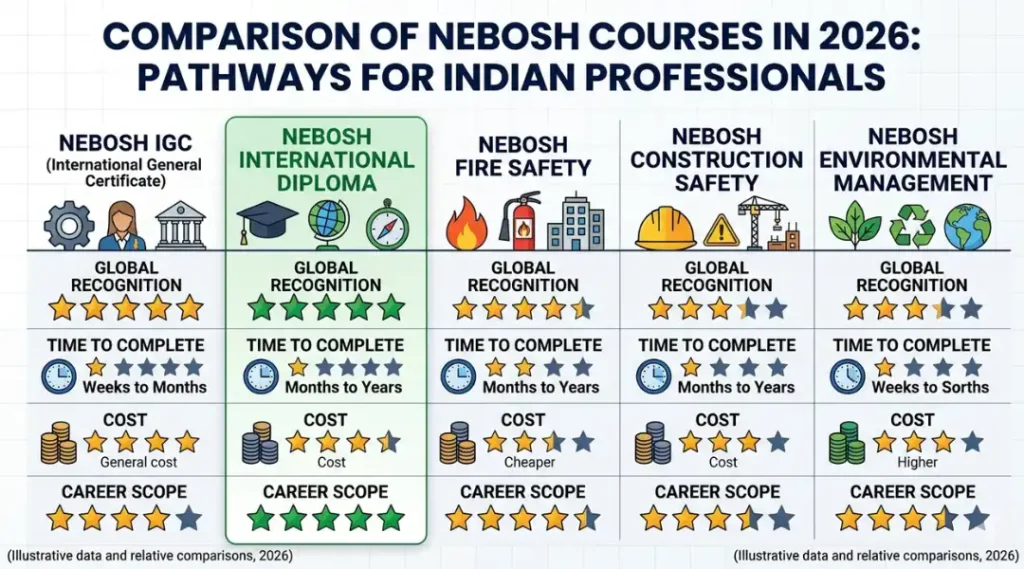
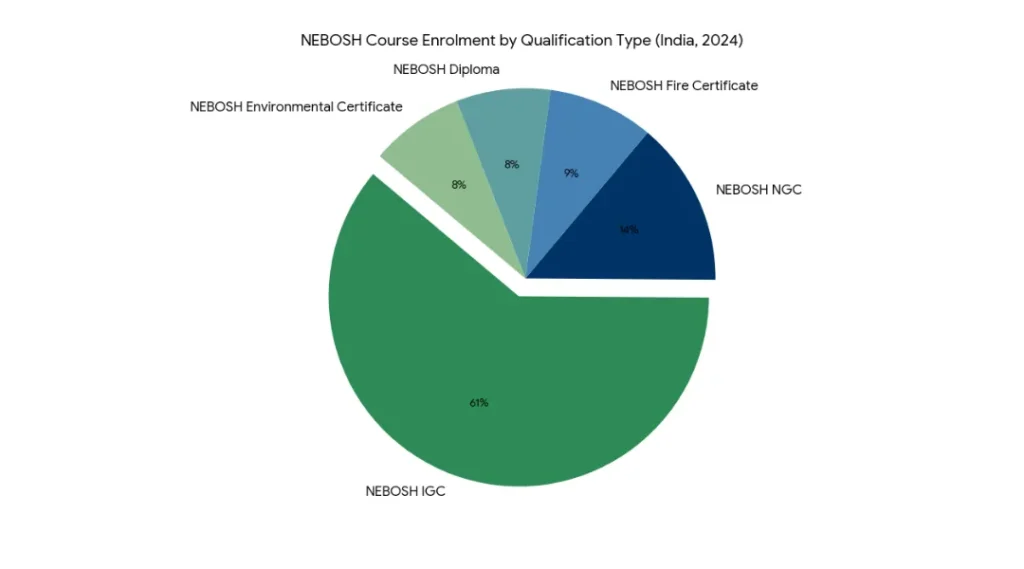
For most Indian safety professionals, the NEBOSH IGC is the correct starting point. It opens the widest range of roles across India, the Gulf, and the UK without over-investing in study time or cost. If your next role is specifically in fire safety or environmental management, a specialist NEBOSH certificate is the better choice. The Diploma is a three-to-four year commitment and is only worth it if you are targeting senior consultancy or management positions.
What makes a NEBOSH course good for the Indian market? Three things: NEBOSH approval status, tutor experience with OBE-format marking, and documented pass rates above the 58% Indian average. Everything else, branding, class size, and extra modules, is secondary.
| NEBOSH Course | Best For | Key Strength | Real Limitation | M2Y Fee (2026) | Verdict |
|---|---|---|---|---|---|
| NEBOSH IGC (International General Certificate) | Safety officers, supervisors targeting Gulf or international roles | Globally recognised and widely respected by employers | OBE format requires analytical writing skill, not just knowledge recall; many candidates underestimate this | ₹48,000–₹50,000 (online) · ₹65,000–₹75,000 (classroom) | Best entry-level certificate for international HSE careers |
| NEBOSH Fire Safety Certificate | Facilities managers, fire safety officers in hospitality, manufacturing, and construction | Specialist qualification for professionals responsible for fire safety and risk management | Narrower career scope than IGC; most employers also value a broader HSE qualification alongside it | ₹28,000–₹36,000 | Best as a second qualification after IGC, not a standalone first certificate |
| NEBOSH International Diploma | Experienced HSE professionals targeting senior or consultancy positions | Advanced NEBOSH qualification for senior health and safety professionals | Requires significant study commitment; better suited to professionals progressing beyond foundation-level qualifications | ₹1,10,000–₹1,40,000 (full programme) | Best for professionals targeting senior HSE or consultancy roles |
| NEBOSH Environmental Management Certificate | EHS professionals, environmental compliance officers, sustainability roles | Useful for environmental compliance, sustainability and EHS responsibilities | Smaller employer base than IGC; most valuable when combined with existing HSE credentials | ₹30,000–₹38,000 | Strong choice for professionals in manufacturing or EHS dual roles |
Which course delivers the best return on investment for someone with no prior HSE qualification? The NEBOSH IGC, without exception. The salary uplift data is consistent: IGC-certified professionals in India earn 22–38% more than equivalent non-certified colleagues in comparable roles (National Safety Council of India, Salary Survey, 2024). The Diploma multiplies that further but requires years, not months.
Benefits of NEBOSH Certification: Real Examples
NEBOSH certification does three specific things for your career: it removes your application from the “unqualified” pile, it gives you a language for risk that employers in multiple countries recognise, and it signals commitment to the profession in a way that short online courses simply cannot. These are not abstract benefits. They translate directly into salary, employment geography, and job security.
Benefit 1: Immediate Salary Impact
IGC-certified safety professionals in India earn a median salary of ₹4.8 lakh per annum versus ₹3.2 lakh for non-certified peers in equivalent roles, a 50% premium in entry-level positions (National Safety Council of India, Salary Survey, 2024). In Gulf-based roles, the gap widens further. NEBOSH-certified safety officers in the UAE report average salaries 35–55% higher than non-certified counterparts doing equivalent work (Gulf Safety Forum, 2024 Employment Data). The certificate does not guarantee a salary increase. But without it, you are negotiating from a weaker position in every job interview.
Benefit 2: Access to International Job Markets
NEBOSH IGC is recognised in 130+ countries as a credible baseline HSE qualification.
This matters specifically for Indian professionals targeting the Gulf. Saudi Aramco, ADNOC, L&T International, and Larsen & Toubro all list NEBOSH IGC as a minimum requirement for HSE supervisor positions on their job portals. Without it, your application does not clear the initial screening, regardless of your years of experience. After working with candidates who spent years trying to get Gulf placements without NEBOSH and then succeeded within months of qualifying, the pattern is consistent and clear.
Benefit 3: Credibility in Workplace Investigations and Audits
A NEBOSH-certified professional is viewed differently during HSE audits and incident investigations.
When a third-party auditor or a regulator visits your site, your qualification signals to them that you speak a common professional language. One client in the chemicals manufacturing sector, a plant in Tamil Nadu, reduced their audit non-conformances by 31% in the 12 months after their HSE team completed NEBOSH IGC. The change was not process-driven. It was driven by how the team now framed risk and documented controls.
Benefit 4: Career Resilience During Industry Downturns
Certified HSE professionals are retained at higher rates during layoffs than uncertified peers.
During the 2023 construction sector slowdown in the Gulf, NEBOSH-certified safety officers were the last to be made redundant in most contractor organisations, and the first rehired. Certification signals a cost to the organisation to lose you. Without it, you are replaceable by the next candidate with field experience.
When NEBOSH Courses Underperform
NEBOSH is not the right tool in every situation. Three specific contexts where it delivers less value than alternatives:
1. You only need site-level safety awareness, not a management-level qualification. If your role is a safety helper or safety steward rather than a safety officer or supervisor, IOSH Working Safely or a DGFASLI basic safety certificate covers your requirement at a fraction of the cost and time.
2. Your employer operates exclusively in India with no international contracts. In this case, a DGFASLI (Directorate General Factory Advice Service & Labour Institutes) advanced diploma may carry more domestic regulatory weight than NEBOSH, and cost 60–70% less.
3. You need a qualification within 30 days. NEBOSH IGC cannot be legitimately completed in under 10 weeks. Any provider claiming otherwise is cutting corners on teaching, not examination. You will still sit a genuine NEBOSH assessment that reflects the gaps.
Common NEBOSH Course Mistakes: How to Fix Them
The most common mistake with NEBOSH courses is choosing a provider based on the lowest fee, which leads to inadequate OBE preparation and a failed first attempt, costing candidates an additional ₹8,000–₹15,000 in resit fees plus months of delay. Most people make it because training fees feel like a cost, not an investment. It is one of the easiest mistakes to fix before you pay anything.
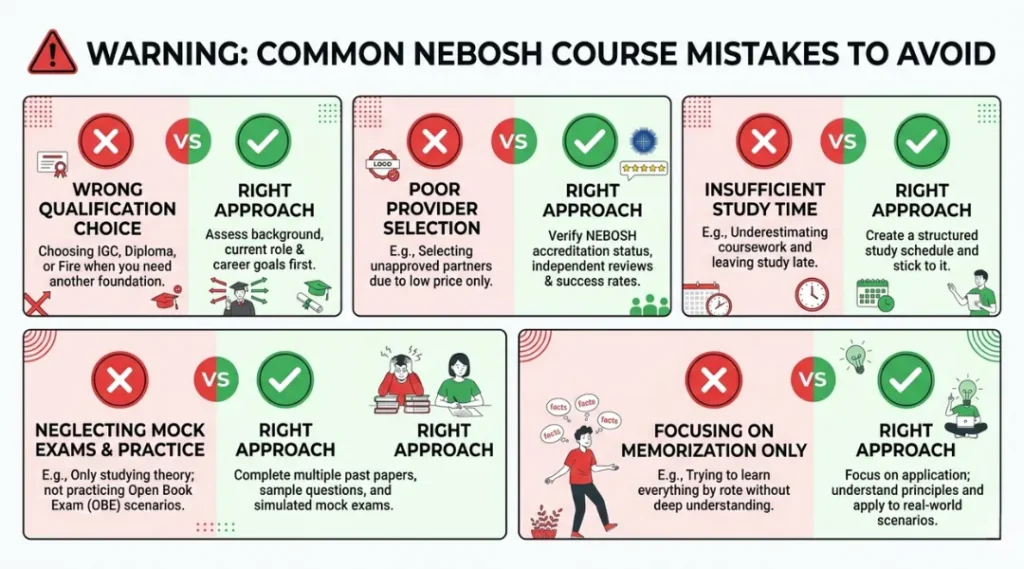
Mistake 1: Enrolling in NGC When You Need IGC
Many candidates, and some low-quality providers, confuse the National General Certificate (NGC) with the International General Certificate (IGC).
The NGC is designed for UK domestic legislation. It is not equivalent to the IGC for Gulf employers, and it cannot be submitted as evidence of NEBOSH qualification in Saudi Arabia, UAE, Qatar, or Oman job applications. This is not a grey area. Gulf employers check which certificate you hold.
Fix: Before enrolling, confirm the full qualification name: “NEBOSH International General Certificate in Occupational Health and Safety.” If your provider’s brochure is not specific, ask them explicitly.
Check now: Look at the certificate specimen on your provider’s website. Does it say “International” or “National”? If you cannot find a specimen, ask before paying.
Mistake 2: Treating the Open Book Examination as an Open Notes Exam
Many candidates assume the 24-hour OBE means they can look everything up and write it down. That misunderstanding is why pass rates in India sit below the global average.
NEBOSH OBE marks analysis and application, not information retrieval. The scenario requires you to diagnose a workplace situation, explain why existing controls are inadequate, and propose practical fixes with reasoning. Candidates who spend their 24 hours searching for facts score poorly. Candidates who have practised OBE scenarios beforehand score well.
Fix: Complete at least three full mock OBE exercises under timed conditions before your sitting. Your Learning Partner should provide these. If they do not, that is a red flag.
Check now: Ask your provider how many mock OBE scenarios are included in your programme. The answer should be at least two, with written tutor feedback on each.
Mistake 3: Submitting NG2 Without a Tutor Review
The NG2 practical assessment accounts for 50% of your final result. Most candidates submit it without ever showing their tutor a draft.
This is not because they are careless. It is because many providers bury the draft review option in their programme materials without making it a required step. Tutors who have marked NG2 assessments know exactly how NEBOSH applies its marking criteria, and a single round of feedback typically moves a candidate from a Pass to a Credit.
Fix: Treat the tutor draft review as non-negotiable. Submit your draft at least two weeks before the final submission deadline.
Check now: Email your Learning Partner now and ask: “Can I submit a draft NG2 for tutor feedback before the final deadline?” If the answer is no, that provider is not giving you what a good NEBOSH programme should include.
Mistake 4: Choosing a Provider Not Listed on NEBOSH’s Official Register
Hundreds of training organisations in India claim NEBOSH affiliation. Not all of them are approved.
A provider can be legitimate, experienced, and well-intentioned, and still not be a current NEBOSH Approved Learning Partner. If they are not listed, your qualification may not be registered with NEBOSH’s official records, which means employers cannot verify it.
Fix: Go to nebosh.org.uk and use the “Find a Learning Partner” tool before paying anything. Search by country or region and confirm your provider appears.
Check now: Open the NEBOSH Learning Partner search right now. Type “India” and see if your provider appears. This takes three minutes and can save you months.
Mistake 5: Underestimating the Study Time for Working Professionals
NEBOSH recommends 150–200 guided study hours for the IGC. Most working professionals budget half that, and struggle accordingly.
NEBOSH content is not difficult. It is substantial. NG1 covers management systems, risk assessment frameworks, health hazards, safety management, workplace environment, and contractor controls. Fitting 200 hours around a full-time job requires genuine schedule planning, not optimism.
Fix: Before enrolling, map 150 hours across your available weekday evenings and weekends over the course duration. If the hours do not fit, extend your timeline, not your study pace.
Check now: Calculate 150 hours across 12 weeks. That is roughly 13 hours per week. Does your schedule actually allow this? If not, a 16–20 week programme is the honest choice.
Quick Win: Mistake 4, verifying provider approval status, takes three minutes and costs nothing. It is the fastest way to protect everything else you invest in this qualification. Do it first, before comparing fees or content.
Real example: A safety professional from Coimbatore enrolled with an unregistered provider offering the IGC at ₹18,000, well below market rate. After completing the programme, he discovered the provider was not on NEBOSH’s register. His result could not be verified. He enrolled again with an approved partner, lost six months, and paid twice. The ₹18,000 saving cost him ₹56,000 and half a year.
Frequently Asked Questions About NEBOSH Courses
NEBOSH qualifications are fully recognised in India across private sector industries including oil and gas, construction, manufacturing, chemicals, and logistics. NEBOSH is not a statutory Indian qualification. Indian regulators reference DGFASLI certifications for legal compliance purposes. For private sector employment and international career mobility, NEBOSH IGC is widely accepted and frequently required by multinational employers operating in India.
Most candidates complete NEBOSH IGC in 10–16 weeks with 150–200 hours of study. Classroom programmes typically run over 10 consecutive study days plus self-study time. Online programmes span 12–16 weeks with scheduled live sessions and self-paced learning. There is no shortcut. NEBOSH controls the examination schedule independently of your Learning Partner. Any provider claiming completion in under 8 weeks is compressing tuition, not the exam.
The first-attempt pass rate for Indian candidates on NEBOSH NG1 (the written unit) is approximately 58%, compared to a global average of 63% (NEBOSH Examiner Report, NG1, 2024). NG2 (the practical assessment) has a higher pass rate, approximately 82% globally, because candidates have tutor support during preparation. The key variable is the quality of Open Book Examination preparation your Learning Partner provides.
NEBOSH IGC fees in India range from ₹38,000 to ₹65,000 depending on delivery format and provider. Online open-book programmes are typically ₹45,000–₹52,000. Classroom programmes with in-person tuition run ₹55,000–₹65,000. NEBOSH's own registration and examination fee (paid through your Learning Partner) is set in GBP and converted, approximately ₹18,000–₹22,000 of your total fee goes directly to NEBOSH. The remainder covers tuition, materials, and support.
Yes. NEBOSH IGC is fully available online through approved Learning Partners, including M2Y Global Academy. The Open Book Examination is conducted online via the myNEBOSH portal. Live online tuition sessions run via platforms like Zoom or Microsoft Teams. The NG2 practical assessment is completed in your own workplace. All you need is a stable internet connection, a laptop or desktop, and a confirmed NEBOSH account.
NEBOSH IGC qualifies you for roles including: HSE Officer, Safety Supervisor, EHS Coordinator, Construction Safety Officer, Site HSE Representative, and Safety Trainer. In the Gulf market, it is the minimum stated requirement for most HSE Officer and above positions. In India, it is the preferred qualification for positions with international contractors, logistics companies, and manufacturing multinationals. Senior roles, such as HSE Manager and Director, typically require the NEBOSH Diploma or equivalent experience in addition.
NEBOSH IGC is significantly more demanding than IOSH Managing Safely in terms of study hours, examination rigour, and content depth. IOSH Managing Safely requires approximately 24–36 hours of study and a short project. NEBOSH IGC requires 150–200 hours and a 24-hour written examination plus a full workplace risk assessment. Employers treat them differently. IOSH is a management awareness certificate; NEBOSH IGC is a professional safety qualification. If your target role requires NEBOSH, IOSH will not substitute.
Yes. NEBOSH does not require prior work experience to enrol in or sit the IGC. The NG2 practical assessment does require access to a workplace for the risk assessment. Candidates without employment typically arrange access through their Learning Partner, a family business, or a volunteer placement. Some providers offer a supervised site visit for NG2 purposes. Confirm this before enrolling if you are not currently employed.
Conclusion
NEBOSH courses are the most recognised professional safety qualifications available to Indian candidates targeting international careers. The IGC is the right starting point for most people, not because it is easy, but because it is the one qualification employers in 130+ countries treat as credible proof that you can manage workplace health and safety without supervision.
Choose an approved Learning Partner. Confirm their pass rate. Practise OBE scenarios before your sitting. Submit a draft NG2 for tutor review. These four steps separate the candidates who pass first time from those who pay for resits.
If you are serious about an HSE career, in India, the Gulf, or internationally, NEBOSH courses are not optional. They are the credential that makes everything else in your application believable.
Your next step: Visit the M2Y Global Academy NEBOSH IGC course page, check the next available start date, and book a free 20-minute enrolment call with a programme advisor. Most candidates who book the call enrol within a week. Most who wait three months are still undecided at month six.