ISO Lead Auditor Course: Online Training for Auditors Worldwide
An ISO Lead Auditor Course trains you to audit a management system against an ISO standard, lead an audit team and report your findings with confidence. It is the step that moves a professional from taking part in audits to running them, whether inside an organisation, across a supply chain, or for a certification body.
M2Y Global Academy delivers its lead auditor training online to learners worldwide, so you can study from wherever you work. This guide explains what the course involves, which standard to choose, who can enrol, how certification works, and what to check before you book any provider.
Quick answer
- What it is: advanced training in auditing management systems against an ISO standard, built on the audit guidance in ISO 19011
- Who it is for: quality, health and safety, environmental and information security professionals, consultants and aspiring auditors
- Standards we cover: ISO 9001 (quality), ISO 14001 (environment), ISO 45001 (occupational health and safety) and ISO/IEC 27001 (information security)
- How you study: online, with live instructor-led sessions [confirm format and schedule]
- How to enrol: message us on WhatsApp, register online or book a free demo
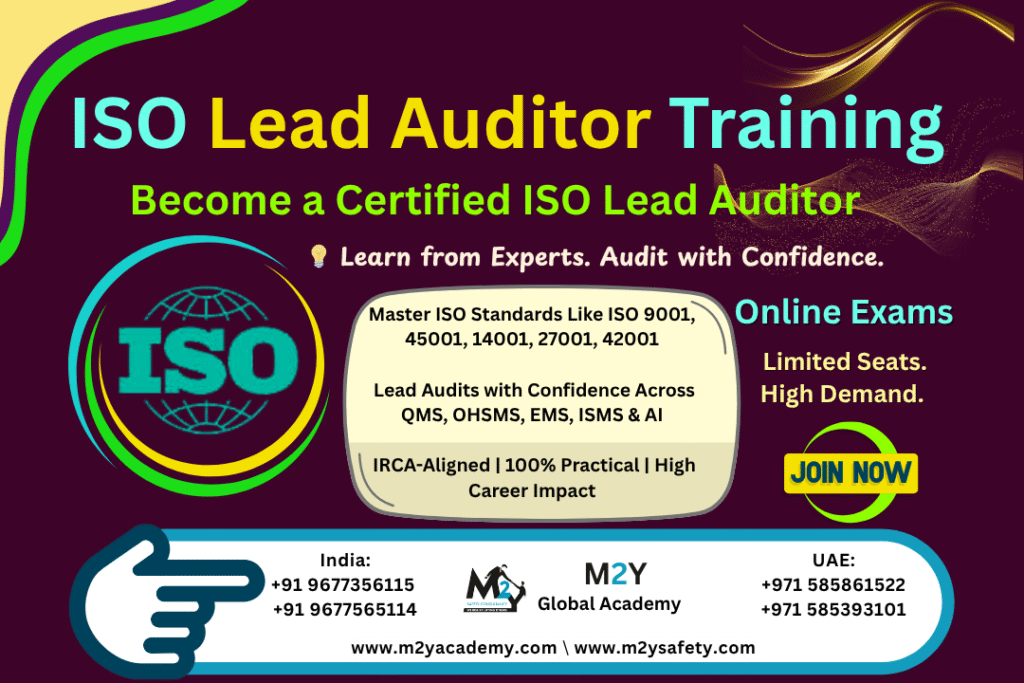
Choose Your ISO Lead Auditor Course
| Course | Standard | Best for |
|---|---|---|
| ISO 9001 Lead Auditor Course | ISO 9001 quality management systems | Quality managers, process owners, supplier and customer auditors, consultants |
| ISO 14001 Lead Auditor Course | ISO 14001 environmental management systems | Environmental and sustainability managers, compliance officers, consultants |
| ISO 45001 Lead Auditor Course | ISO 45001:2018 occupational health and safety management systems | HSE managers, safety officers, HR and compliance teams |
| ISO/IEC 27001 Lead Auditor Course | ISO/IEC 27001:2022 information security management systems | IT, information security, risk and compliance professionals |
Edition covered by each M2Y course: [Confirm for each course which edition of the standard the training covers. See the standards update section below.]
Which course should I take?
- Choose the standard that matches your current role or the audits you want to lead.
- If you work in HSE, the ISO 45001 course is the natural fit, and it pairs well with NEBOSH or IOSH qualifications.
- Quality and environmental professionals often add a second standard later, because ISO 9001, 14001, 45001 and 27001 share the same Harmonized Structure, so the audit skills transfer.
What Is a Lead Auditor?
A lead auditor is a trained and competent professional who leads an audit team through a full management system audit. They plan the audit, assign tasks to team members, run the opening and closing meetings, judge audit evidence, write the findings and report to the organisation.
Lead auditor vs internal auditor
| Internal auditor | Lead auditor | |
|---|---|---|
| Typical scope | Audits within their own organisation, often parts of the system | Leads full management system audits, including audits of suppliers or on behalf of a certification body |
| Team role | Member of an audit team or sole internal auditor | Leads the audit team |
| Responsibility | Collects evidence and reports on assigned areas | Plans the audit, manages the team, decides on findings and reports the overall result |
| Typical training | Internal auditor course | Lead auditor course |
How auditor competence is recognised
Organisations and certification bodies judge auditors on training, audit experience and demonstrated competence. Individual auditor certification schemes generally recognise higher levels of auditor status as you gain audit experience after completing an approved course, and certification bodies set their own competence rules for the auditors they use. ISO/IEC 17021-1 sets out the principles and requirements for bodies that audit and certify management systems, including competence, consistency and impartiality.
In practice, this means a course certificate is the first step, and your audit log and practical experience carry real weight afterwards. Whichever provider you choose, ask which scheme approves the course and what you need to do next to register or progress.
Who Should Take an ISO Lead Auditor Course?
- Quality, HSE, environmental and information security managers
- Internal auditors who want to lead audit teams
- Consultants and trainers who support ISO certification
- Professionals who want to work as second-party (supplier) or third-party auditors
- Managers who face regular customer, supplier or certification audits and want to understand them from the auditor’s side
Strong interest in auditing matters more than a specific job title.
Eligibility and Prerequisites
Entry requirements depend on the course and the certification scheme behind it. In general, providers expect:
- A working knowledge of the relevant ISO standard (for example, the clauses of ISO 9001)
- Some understanding of management systems and basic audit principles
- Good English, since training and assessment are in English [confirm]
M2Y entry requirements: [Confirm: required education, experience, any prior course, and language level.]
Not sure whether you meet the requirements? Message our team with your background and we will advise you before you pay.
What You Will Learn
Lead auditor training combines audit theory, standard-specific knowledge and practical exercises. Typical content, built around the guidance in ISO 19011 (guidelines for auditing management systems), includes:
- Audit principles and the audit programme: integrity, fair presentation, evidence-based approach, risk-based thinking
- The management system standard: how to read each clause from an auditor’s point of view
- Planning an audit: scope, criteria, objectives, audit plan and team selection
- Conducting the audit: opening meeting, interviews, document and record review, observation, sampling and gathering audit evidence
- Findings: writing clear nonconformities and distinguishing conformity, nonconformity and opportunities for improvement
- Reporting and closing: closing meeting, audit report and follow-up on corrective actions
- Leading people: managing an audit team and handling difficult situations professionally
The audit process at a glance
- Start the audit: confirm scope, objectives and criteria
- Prepare: review documents, prepare the plan and assign tasks
- Conduct: hold the opening meeting, collect and verify evidence, evaluate against criteria
- Report: document findings and conclusions and agree them in the closing meeting
- Complete and follow up: close the audit and verify corrective action
Check ISO’s page for the current status and edition of ISO 19011 before you cite it in your own materials. Some standards bodies list a revision in draft.
Course format: most lead auditor programmes include lectures, group case studies, role-play audits and an exam. [Confirm M2Y’s course structure: number of sessions, hours, exercises and exam.]
Study Online with M2Y, Wherever You Are
M2Y Global Academy offers lead auditor training online to learners worldwide. Our online format is designed for working professionals who cannot take time away from their jobs.
What online learners can expect [confirm each point before publishing]
- Instructor-led live sessions with the opportunity to ask questions
- Group exercises and mock audit practice
- Course materials and exam preparation guidance
- Support from the M2Y team before, during and after the course
What you need
- A reliable internet connection and a modern computer, laptop or tablet
- A quiet space and time for live sessions and exercises
- Strong reading and writing skills in English
- Time for revision and the exam
Exam and Certification
At the end of a lead auditor course, learners are normally assessed through an exam and continuous assessment of exercises. What the certificate means depends on the certification scheme behind the course.
M2Y certification scheme: [State exactly which body certifies or approves your lead auditor courses, with a link to that body’s official page for each course and the course reference where one exists.]
Questions to ask any provider, including us
- Which body certifies or approves this course for this exact standard and edition?
- Can I verify the course on that body’s official website?
- What does the exam involve, and what is the pass mark?
- What do I need to do after the course to register as an auditor?
- Is the exam fee included?
Be careful with providers that only say “internationally recognised”. Recognition depends on the scheme, the standard and the employer, so always confirm the specifics.
Fees and Next Course Dates
Course | Fees & Next Batch Details |
|---|---|
ISO 9001 Lead Auditor | |
ISO 14001 Lead Auditor | |
ISO 45001 Lead Auditor | |
ISO/IEC 27001 Lead Auditor |
For course fees, study materials, examination details, certification, and upcoming batch dates, contact our training coordinator.
Career Opportunities After Lead Auditor Training
A lead auditor qualification can support roles such as:
- Internal lead auditor in manufacturing, healthcare, construction, oil and gas, IT and services
- Second-party auditor assessing suppliers for large organisations
- Third-party auditor with a certification body, where the body sets its own competence and experience rules under ISO/IEC 17021-1
- Management system consultant or trainer
- Senior quality, HSE, environmental or compliance roles that oversee audits and corrective action
Salaries and job requirements vary by country, sector and employer, so check job advertisements in your own market. For HSE careers you can also read our guide to the top 50 HSE job interview questions.
Building on your lead auditor qualification
| If you want to… | Consider |
|---|---|
| Add health and safety qualifications | NEBOSH International Diploma or IOSH Level 6 Diploma |
| Move into senior HSE leadership | OTHM Level 7 Diploma in OHS Management or Certified Safety Professional (CSP) |
| Strengthen risk skills | OTHM Level 7 Diploma in Risk Management |
| Add environmental credentials | OTHM Level 7 Diploma in Environmental and Sustainability Management |
| Add US-standard safety training | OSHA 30-Hour |
| Explore other training | All M2Y HSE training |
Standards Update: What Auditors Need to Know in 2026
ISO standards are revised on a regular cycle, and auditors must audit against the edition their client is certified or transitioning to. Current position as of late October 2026:
| Standard | Status |
|---|---|
| ISO 9001 | ISO 9001:2026 was published on 16 September 2026. It is the sixth edition and replaces ISO 9001:2015. DNV reports a three-year transition, with ISO 9001:2015 certificates ceasing to be valid after 30 September 2029 |
| ISO 14001 | ISO 14001:2026 is the fourth edition, published in April 2026, replacing ISO 14001:2015. A transition period is underway. LRQA says organisations must transition before May 2029 |
| ISO 45001 | ISO 45001:2018 remains the current edition. ISO lists a draft revision, so watch for announcements |
| ISO/IEC 27001 | ISO/IEC 27001:2022 is the current edition |
Transition dates are set by accreditation bodies and certification bodies, so confirm the rules that apply to your client. Useful references: DNV on the ISO 9001:2026 transition and LRQA’s overview of the ISO 9001, 14001 and 45001 revisions.
What this means for your training: choose a course whose content and certification match the edition you will audit.
How to Choose a Lead Auditor Course Provider
Use this checklist whichever provider you consider:
- Certification: the course is approved or certified by a named body for your standard and edition, and you can verify it on that body’s website
- Trainers: experienced auditors who can describe real audit work, not only theory
- Practice: case studies, role-play audits and feedback, not slides only
- Exam clarity: you know the format, pass mark, retake rules and fees before you pay
- Edition: the course covers the version of the standard you need
- Support: help before and after the course, including how to register as an auditor
- Honest claims: no vague promises about jobs, salaries or pass rates
Frequently Asked Questions
It is advanced training that prepares you to plan, lead and report audits of a management system against an ISO standard such as ISO 9001, ISO 14001, ISO 45001 or ISO/IEC 27001. It builds on the audit principles in ISO 19011.
An internal auditor typically audits within their own organisation, often parts of the system. A lead auditor is trained to lead an audit team through a full management system audit, including audits of suppliers or on behalf of a certification body.
Pick the standard that matches your work: ISO 9001 for quality, ISO 14001 for environment, ISO 45001 for occupational health and safety, and ISO/IEC 27001 for information security. Because these standards share a common structure, the skills carry over if you add a second course later.
Yes. M2Y Global Academy offers its lead auditor training online to learners worldwide.
Requirements depend on the course and scheme. Many providers expect knowledge of the standard and basic audit principles rather than formal audit experience, though auditor certification schemes may require audit experience for higher levels. Confirm M2Y's entry requirements before you enrol.
Recognition depends on the certification scheme, the standard and the employer. Ask which body approves the course, verify it on that body's website, and confirm what you must do to register as an auditor afterwards.
Certification bodies set their own competence and experience requirements for auditors, based on frameworks such as ISO/IEC 17021-1. A course is usually one part of that route, alongside audit experience and the body's own assessment.
Register online, book a free demo, contact us, or message us on WhatsApp.