Certified Safety Professional (CSP) Certification: Course and Training
The Certified Safety Professional (CSP) is awarded by the Board of Certified Safety Professionals (BCSP). It is aimed at safety practitioners who carry real responsibility for safety leadership: setting safety culture, running safety management systems, assessing risk, investigating incidents and preparing emergency response plans.
Getting there takes more than studying. You need to meet BCSP’s education, experience and prior-credential requirements first, and then pass a 5.5-hour exam. This guide explains each step in plain language, using BCSP’s own published requirements, and shows how M2Y Global Academy’s CSP course and training supports you from eligibility check to exam day.
Check my CSP eligibility on WhatsApp | Book a free demo | Contact us
CSP Certification at a Glance
| Detail | Information |
|---|---|
| Credential | Certified Safety Professional (CSP) |
| Awarded by | Board of Certified Safety Professionals (BCSP), Indianapolis, USA |
| Education | At least a bachelor’s degree in any field |
| Experience | 4 years of safety, health and environment (SH&E) experience, at least 50% of it preventative, professional-level work with breadth and depth of safety duties |
| Prior credential | A BCSP-qualified credential (see list below) |
| Exam | Computer-based, 5.5 hours, delivered at Pearson test centers |
| Application fee | US$160 |
| Exam fee | US$350 (US$494 if bought as the application and exam combo) |
| Annual renewal | US$185 |
| Recertification | 25 points every 5 years, including 0.5 points from ethics courses |
Sources: BCSP CSP page and BCSP’s Credentials At-A-Glance (PDF). BCSP states that fees and passing scores can change without notice, so confirm current figures on bcsp.org before you pay.
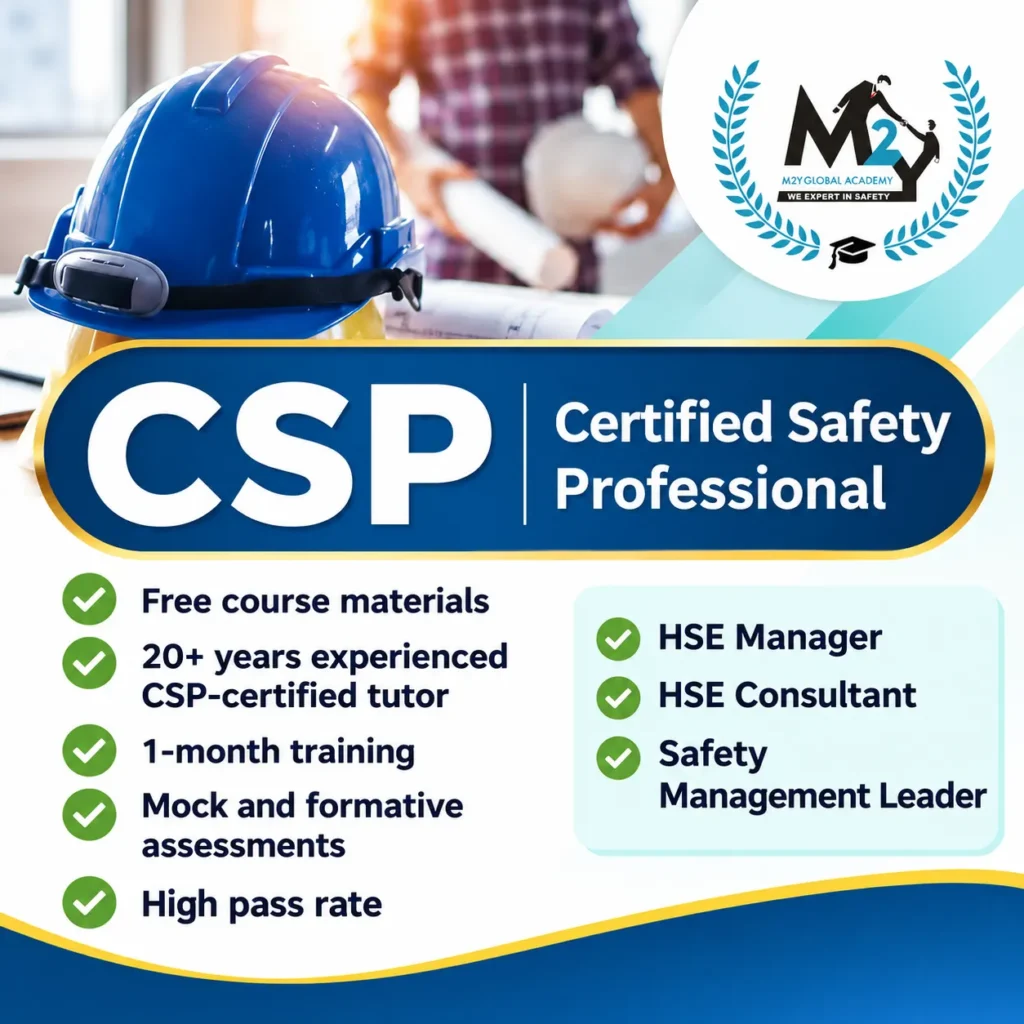
CSP Training | Info |
Last Date for Registration | 28 November 2026 |
Who Should Pursue the CSP?
The CSP suits practitioners who already work in, or are moving toward:
- HSE manager, HSE lead or HSE director roles
- Corporate or multi-site safety leadership
- Safety, risk and compliance consulting
- Safety management system design and auditing
- Roles in oil and gas, construction, manufacturing, logistics, aviation and facilities
It is not a first-step qualification. BCSP requires another qualified credential before you can apply, so most candidates build up to it. If you are earlier in your career, see the pathway section below.
CSP Eligibility Requirements (Step by Step)
You must meet all of these before BCSP approves your application:
- Education: a bachelor’s degree at minimum. If your degree is from outside the United States, BCSP has it evaluated for US equivalency. BCSP points applicants to its evaluation partner, Education Perspective, for the documents required.
- Experience: four years of SH&E experience, at least 50% of it preventative, professional-level work with breadth and depth of safety duties.
- A BCSP-qualified credential, such as one of those below.
- Passing the CSP exam.
- Maintaining certification through the annual renewal fee and recertification.
Applicants must also disclose any criminal convictions or any suspension, revocation or probation of a professional licence or credential. BCSP reviews this confidentially and may deny an application based on it.
BCSP-qualified credentials that satisfy requirement 3
BCSP’s current list includes:
- Associate Safety Professional (ASP)
- Graduate Safety Practitioner (GSP)
- Transitional Safety Practitioner (TSP)
- Certified Industrial Hygienist (CIH)
- Chartered Member of IOSH (CMIOSH) and Chartered Fellow of IOSH (CFIOSH)
- Canadian Registered Safety Professional (CRSP)
- NEBOSH National or International Diploma in Occupational Health and Safety
- Master in Occupational Safety and Health, ITC-ILO
- Professional Member of the Singapore Institution of Safety Officers (SISO)
- Diploma or certificate in industrial safety issued by State Government Boards of Technical Education in India
- Certified Safety Engineer (CSE) administered by SAWS, China
- Professional Certificate in Safety and Occupational Health, US Army Combat Readiness Center
The list can change. Always check the live list on the BCSP CSP page.
Where do GSP and TSP fit?
- GSP (Graduate Safety Practitioner) is for holders of a bachelor’s or master’s degree from a BCSP Qualified Academic Program. No experience is required for the GSP itself, but you must earn the CSP within the eligibility period once you meet the experience requirement.
- TSP (Transitional Safety Practitioner) is for holders of a credential from a BCSP Qualified Equivalent Program.
Not sure which route fits your qualifications? Send us your certificates and we will map them against BCSP’s current requirements before you apply.
CSP Exam Blueprint: What the Exam Covers
BCSP’s current exam blueprint, CSP11, groups the exam into seven domains. Weightings below come from BCSP’s CSP exam blueprint (PDF).
| Domain | Weight | Examples of what is tested |
|---|---|---|
| 1. Advanced Application of Safety Principles | 25% | Prevention through design, process safety, workplace hazards, life safety features, fleet safety, materials handling, tools and machinery |
| 2. Program Management | 25% | Gap analysis, incident investigation and root causes, management of change, system safety analysis, leading and lagging indicators, management systems and audits (including ISO 45001), budgeting, leadership, project management, data analysis |
| 3. Risk Management | 15% | Risk evaluation process, job hazard and process hazard analysis, hierarchy of controls, financial risk strategies |
| 4. Emergency Management | 9% | Emergency response plans, disaster response and recovery, fire protection systems, hazmat transport, workplace violence prevention |
| 5. Environmental Management | 6% | Pollution prevention, hazardous materials and waste management, sustainability, environmental impacts |
| 6. Occupational Health and Applied Science | 10% | Exposure measurement, toxicology, public health, ergonomics, chemistry and physics basics |
| 7. Training | 10% | Needs assessment, program design, adult learning, evaluating training effectiveness |
What this means for your study plan: Domains 1 and 2 together carry half of the exam, so they deserve the largest share of your study time. Domains 4 and 5 are smaller but still need coverage.
The blueprint is updated from time to time. Download the latest version, plus the CSP exam references list (PDF), directly from BCSP before you start studying.
CSP Cost Breakdown (BCSP Fees)
| Item | Fee (USD) |
|---|---|
| Application | $160 |
| Exam (single attempt) | $350 |
| Application + exam combo | $494 |
| Exam bundle (two attempts + one self-assessment) | $600 |
| Application + exam bundle combo | $744 |
| Eligibility extension (one year) | $100 |
| Annual renewal | $185 |
You have one year from application approval to take and pass the exam, and you must wait at least six weeks between exam attempts.
Fees from BCSP’s Credentials At-A-Glance (version dated 1 April 2026). Fees are charged by BCSP, separately from M2Y’s course fee.
How to Apply and Sit the CSP Exam
- Create your account and start your application through My Profile on bcsp.org.
- Submit documents for your education, experience and qualified credential.
- Pay the application fee. BCSP reviews your application once it is submitted and paid.
- Buy the exam during the application, or after approval.
- Schedule at a Pearson test center. Exams are computer-based, and official results are available as soon as you submit.
- Maintain your CSP with the annual fee and recertification points every five years.
M2Y CSP Course and Training
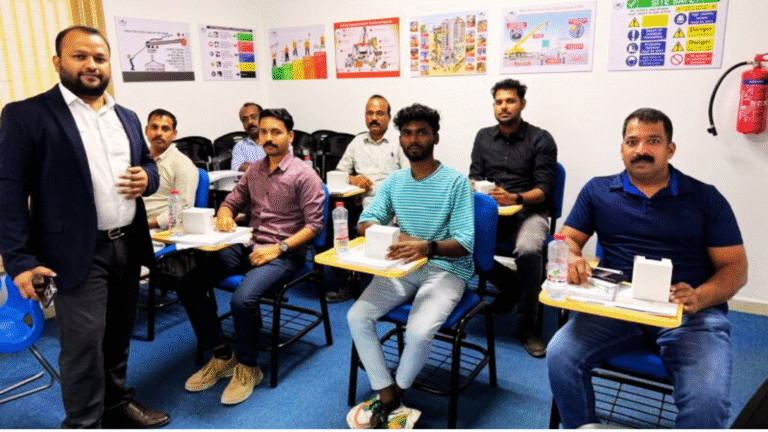
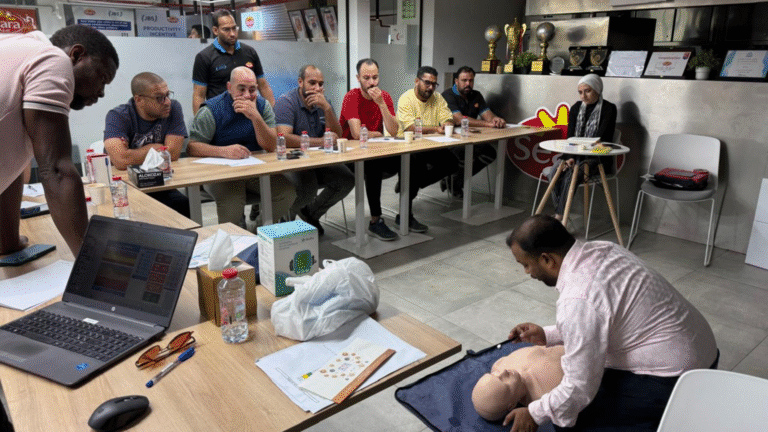
M2Y’s CSP training is built around BCSP’s published exam blueprint, so your study time follows the weighting of the real exam.
What the programme covers
- All seven blueprint domains, with extra time on Advanced Application of Safety Principles and Program Management
- Worked scenario questions and case studies
- Practice questions and mock exams to build exam stamina
- Calculation and data-analysis practice (exposure, statistics, risk and cost-benefit)
- Eligibility and application guidance before you pay BCSP
Build Your Path to the CSP
| Where you are now | Next step with M2Y |
|---|---|
| Starting in safety | NEBOSH IGC or IOSH Managing Safely |
| Building to degree level | OTHM Level 6 Diploma in OHS or IOSH Level 6 Diploma |
| Holding a NEBOSH Diploma | Check eligibility, then start CSP preparation |
| Moving into leadership | NEBOSH International Diploma or OTHM Level 7 Diploma in OHS Management |
| Strengthening management-system skills | ISO 45001:2018 OHSMS Lead Auditor |
| Working to US standards | OSHA 30-Hour |
Some Level 6 diplomas may qualify toward BCSP’s TSP pathway. BCSP decides which programmes qualify, so ask us to check the current list for your qualification.
Career Value of the CSP
BCSP positions the CSP as a credential for safety leadership, and many senior HSE job advertisements ask for it or for equivalent credentials. The value depends on your role, employer and region, so check the data yourself:
- Use BCSP’s Safety Salary Calculator for current salary information.
- Search the BCSP Career Center to see roles asking for the CSP.
- Confirm a certificate holder’s status in BCSP’s Credential Holder Directory.
Preparing for interviews? See our guide to the top 50 HSE job interview questions.
Frequently Asked Questions
It is a credential awarded by the Board of Certified Safety Professionals (BCSP) to safety practitioners with a bachelor's degree, four years of qualifying experience, a BCSP-qualified credential and a pass in the CSP exam.
You need at least a bachelor's degree, four years of SH&E experience (at least 50% preventative, professional-level work), and a BCSP-qualified credential such as ASP, GSP, TSP, CIH, CMIOSH, or a NEBOSH Diploma. See the full list on the BCSP site.
A NEBOSH National or International Diploma in Occupational Health and Safety is on BCSP's list of qualified credentials. You still need the degree, the experience and a pass in the CSP exam.
Yes, but BCSP evaluates degrees from outside the United States for US equivalency. Your application will ask for supporting documents.
BCSP's fees are US$160 for the application and US$350 for the exam (US$494 for the combo), then US$185 a year to renew. M2Y's course fee is separate.
The exam is 5.5 hours, computer-based, and delivered at Pearson test centers.
You must wait at least six weeks between attempts. BCSP also offers an exam bundle that includes two attempts and one self-assessment.
You have one year from approval of your application. If you are within 60 days of your deadline, you can pay a one-time US$100 eligibility extension for one more year.
Pay the annual renewal fee and earn 25 recertification points every five years, including 0.5 points from ethics courses.
No. A course helps you prepare, but BCSP's eligibility rules and exam are separate, and BCSP decides your application.