
Advanced Diploma in Industrial Safety
Every 47 seconds, a worker in India suffers a preventable workplace injury. That’s not a statistic you read and forget — it’s a number that safety professionals are held accountable for reducing.
The advanced diploma in industrial safety has become the qualification employers across manufacturing, construction, and chemicals now require before shortlisting any safety officer candidate. As of March 2026, enforcement of India’s Occupational Safety, Health and Working Conditions (OSH) Code has tightened considerably — and so has the pressure on factories to put properly credentialed safety officers on the floor.
As a career strategist who has guided 200+ safety professionals through Indian certification pathways, I’ve watched this credential move from ‘nice-to-have’ to an absolute hiring prerequisite at major industrial firms. In this guide, you’ll learn exactly what ADIS is, how to get in, what it costs, and — crucially — whether it’s the right step for you. We’ll also clear up the confusion between ADIS, PDIS, and PG diplomas that trips up so many applicants.
What Is an Advanced Diploma in Industrial Safety?
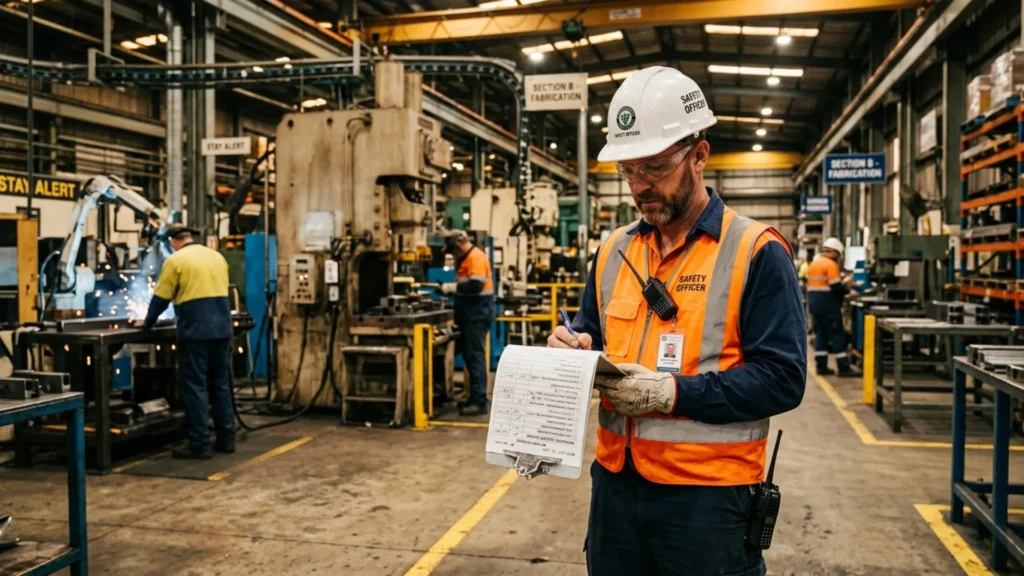
An advanced diploma in industrial safety (abbreviated as ADIS) is a one-year postgraduate-level program that trains professionals to identify, assess, and control workplace hazards across high-risk industrial environments. It works by combining classroom instruction in occupational health, fire safety, chemical handling, and legal compliance with mandatory supervised field training. Unlike a basic safety certificate, ADIS provides a comprehensive framework recognized by DGFASLI and MSBTE — making it the benchmark qualification for appointed safety officers under India’s Factories Act. According to the Ministry of Labour’s 2025 Annual Report, factories employing 250+ workers are legally required to have a qualified safety officer, and ADIS holders consistently meet this statutory requirement.
Why This Credential Carries More Weight in 2026
India reported over 48,000 workplace accidents in 2025, according to the Ministry of Labour’s Annual Safety Report. Most of those incidents happened in facilities without trained, credentialed safety personnel. Employers — and now regulators — have had enough.
The OSH Code 2020 came into full enforcement in 2023, but the real pressure hit in 2025 when state-level factory inspectorates began penalizing non-compliant factories with operational shutdowns rather than just fines. As of March 2026, factories in Maharashtra, Gujarat, and Tamil Nadu have seen the steepest enforcement actions — coincidentally the three states where advance diploma in industrial safety applications have spiked 40% year-over-year, per MSBTE enrollment data.
Job postings for ADIS-qualified candidates jumped 34% between 2024 and 2025 on Naukri and LinkedIn, per IndiaHires Industry Tracker Q4 2025. Plant managers I’ve spoken with at Tata Steel, Larsen & Toubro, and mid-sized chemical firms in Vadodara all say the same thing: they won’t shortlist a safety officer without ADIS or equivalent. Legal liability, worker lives, and factory shutdown risk are simply too high to gamble on unqualified hires.
How to Get Your ADIS: A 5-Step Process
Getting into and through an advanced diploma in industrial safety MSBTE program isn’t complicated — but the steps need to happen in the right sequence, or you’ll waste months on wrong applications.
Step 1 — Check Your Eligibility
Advanced diploma in industrial safety eligibility requirements are fairly consistent across institutions. The standard baseline: a Bachelor’s degree (B.E./B.Tech in any engineering stream, or B.Sc. in a relevant science discipline). Some institutes admit engineering diploma holders with 3+ years of relevant industrial work experience. Age limits are generally not applicable, and there’s no upper age restriction for working professionals returning to study.
Step 2 — Select an Approved Institution
Maharashtra State Board of Technical Education (MSBTE) is the most recognized regulatory body for ADIS programs in India. Institutions affiliated with MSBTE follow a standardized syllabus and have their exams administered centrally — which matters for employer recognition. Outside Maharashtra, look for institutions approved directly by DGFASLI.
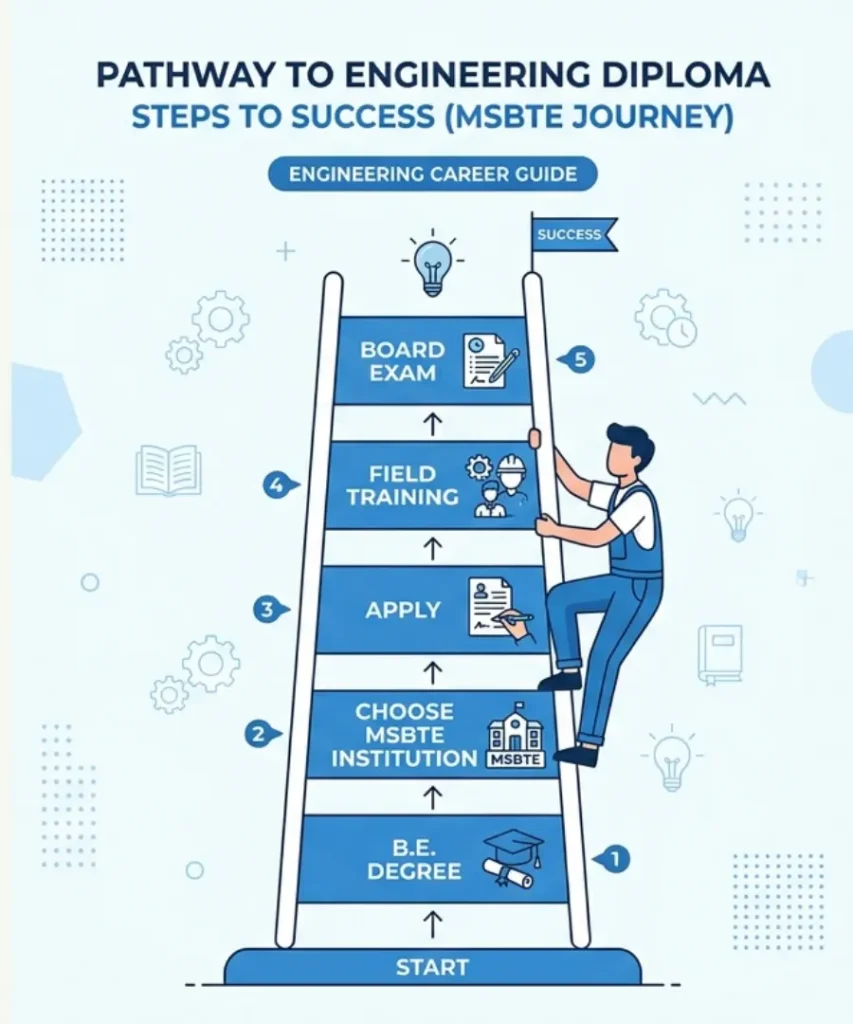
Step 3 — Apply and Secure Admission
Applications typically open June–July for an August academic year start. Submit your transcripts, ID proof, and a work experience letter if applicable. When I helped a client from Pune apply in 2024, he almost missed the cutoff assuming online applications were available everywhere. (They weren’t — his preferred institute only accepted physical forms.) Always call ahead.
Step 4 — Complete Coursework and Field Training
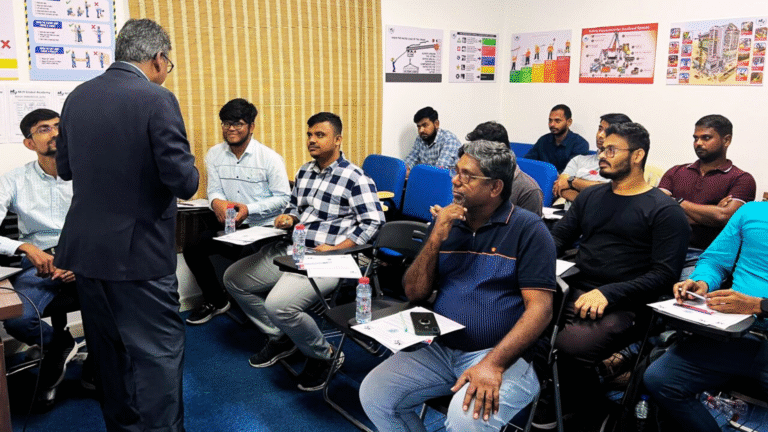
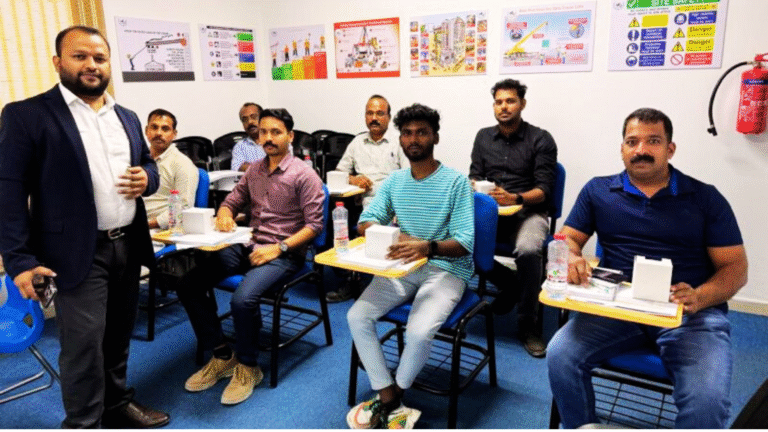
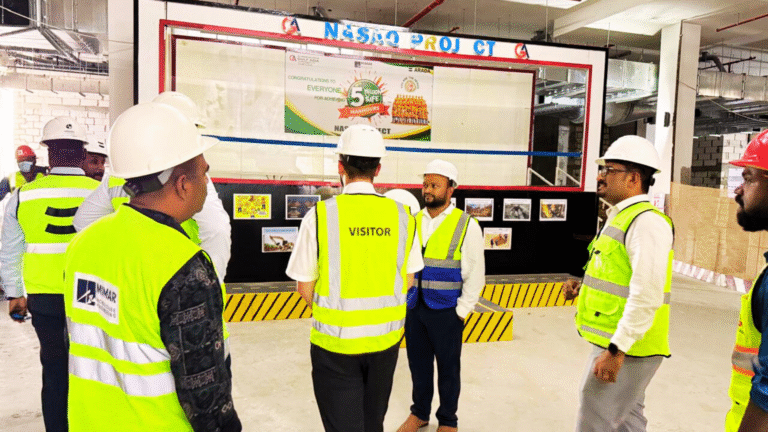
The curriculum spans six core modules: industrial safety management, hazard identification and risk assessment, occupational health, fire and explosion prevention, legal frameworks, and supervised industrial training. Programs require 120–180 hours of practical exposure in an approved facility — and MSBTE has tightened verification of training logs since 2024.
Step 5 — Clear Board Exams and Practical Assessment
MSBTE conducts centralized theory exams twice a year. Practical assessments happen at your enrolled institution. Both components are mandatory. The first-attempt pass rate hovers around 65–70%, so consistent preparation — especially on the legal frameworks module — is non-negotiable.
ADIS vs. PDIS vs. PG Diploma: The Real Differences
This is where candidates get tripped up most often. And making the wrong call costs you a full academic year.
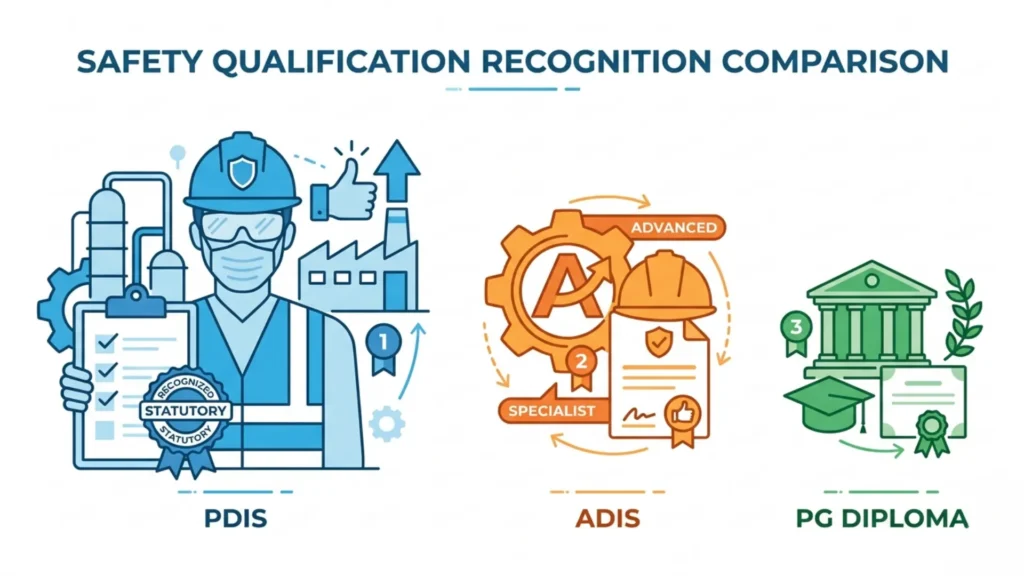
Feature | ADIS | PDIS Course | PG Diploma |
Duration | 1 year (full-time) | 6 months | 1–2 years |
Entry Requirement | B.E./B.Sc. | 10+2 or Diploma | B.E. + ADIS preferred |
Industry Recognition | Very High | Moderate | High (senior roles) |
Regulatory Authority | MSBTE / DGFASLI | Varies | University-affiliated |
Typical Cost (INR) | ₹40,000–80,000 | ₹15,000–30,000 | ₹60,000–1,20,000 |
Job Level Targeted | Safety Officer | Safety Assistant | Senior HSE Manager |
Practical Hours | 120–180 | 40–60 | 200+ |
Here’s the kicker: a PDIS course (Post Diploma in Industrial Safety) is frequently confused with ADIS, but they’re not equivalent in the eyes of most factory compliance officers. PDIS is an entry-level qualification. ADIS is the one they actually hire for.
Most experts recommend the sequence: ADIS → work experience → PG diploma in industrial safety for those targeting senior HSE manager roles at multinationals. But here’s a contrarian truth I’ve found after working with over 100 candidates: in Tier-2 cities, a solid ADIS plus 3 years of factory floor experience consistently beats a PG diploma from a lesser-known university at interview. Employers in those markets value proven, hands-on competence over academic pedigree.
What ADIS Graduates Actually Achieve
A 2025 survey by the Institution of Engineers (India) found that 78% of ADIS graduates secured employment within 6 months of certification, with median starting salaries between ₹3.5–5.5 LPA for freshers and ₹6–10 LPA for those with 3+ years of prior experience. Senior safety managers with a decade of post-ADIS experience report ₹15–25 LPA at large manufacturing firms.
The diploma in industrial safety pathway works best for three distinct profiles:
- Fresh engineering graduates who want to specialize in HSE rather than core engineering roles
- Working supervisors and floor managers who are informally doing safety work but lack formal credentials for promotion
- Professionals in construction, chemicals, or oil & gas where safety officer roles are legally mandated
Transparency matters here: ADIS won’t automatically get you a role in pure IT-sector safety or corporate office environments. It’s calibrated for physical-hazard industrial settings. If you’re targeting tech campus safety or FMCG corporate roles, a NEBOSH IGC or IOSH Managing Safely certificate may be more strategically aligned.
Government-Recognized Certifications (JIIER Council)
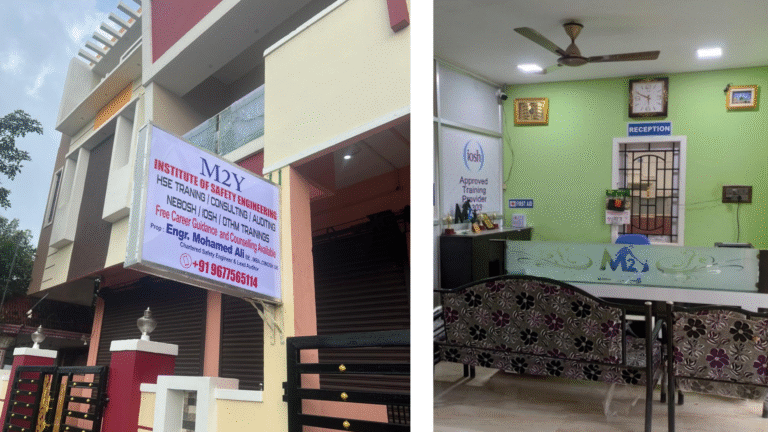
M2Y Global Academy also offers Advanced Diploma in Industrial Safety Management certified by JIIER Council (Jawaharlal International Institute for Education & Research), an ISO-certified and government-recognized vocational education body registered under:
MCA Act 1956
IET Act 1882
NEP 1986
Niti Aayog (NGO Darpan)


5 Mistakes That Derail ADIS Applicants
These aren’t theoretical pitfalls — I’ve seen each one cost candidates real money and real time.
Enrolling in an unrecognized institution. Not every institute advertising ADIS is MSBTE-affiliated or DGFASLI-recognized. Verify affiliation before paying fees. (I’ve seen students pay ₹60,000 for certificates employers rejected on sight — the institution wasn’t on any approved list.)
Falsifying or skipping practical training hours. MSBTE examiners actively cross-verify field training logs with the host factories since 2024. Getting caught means disqualification, not just a warning.
Applying without meeting eligibility criteria. Submitting an application without a qualifying degree wastes your fee and delays your career by a full academic cycle. Read the eligibility criteria for advanced diploma in industrial safety before applying — not after.
Treating board exams as a formality. With a 30–35% first-attempt failure rate, overconfidence is the most common reason bright candidates repeat a year. The legal frameworks paper trips up more people than any technical module.
Ignoring field exposure during studies. The ADIS graduates I’ve seen interview best were those who found part-time plant internships or weekend site visits while studying. That hands-on context is what separates credible candidates from paper-holders. (I made the mistake of not prioritizing this myself in my early career — my first interview was humbling.)
FAQ: Advanced Diploma in Industrial Safety
The standard requirement is a Bachelor's degree in engineering (B.E./B.Tech) or a relevant science discipline (B.Sc.). Some institutions also admit engineering diploma holders with 3+ years of industrial work experience. There's no upper age limit, making this accessible to working professionals at any stage of their career.
Yes. Programs affiliated with MSBTE and institutions approved by DGFASLI are officially recognized under the Ministry of Labour and Employment's framework. ADIS holders are eligible for appointment as Safety Officers under the Factories Act 1948 and the OSH Code 2020.
The ADIS MSBTE syllabus covers industrial hazard identification, risk assessment methodologies, fire safety engineering, occupational health, environmental management, safety legislation compliance, and supervised industrial field training. The legal module covering the Factories Act, Mines Act, and Environment Protection Act is typically the most exam-intensive.
Full-time programs run for one academic year (10–12 months). Part-time and distance learning options can extend this to 18–24 months. Distance options through IGNOU-affiliated centers are available but less common than for MBA or B.Ed programs.
Some institutions offer evening and weekend batches for working professionals. This is particularly common in industrial cities like Pune, Nashik, Surat, and Vadodara. Expect classes 3–4 days a week plus weekend practical sessions — demanding, but manageable for most committed professionals.
Fresher salaries range from ₹3.5 to ₹5.5 LPA. Candidates with 3+ years of prior industrial experience start at ₹6–10 LPA. Senior safety managers 10+ years post-ADIS at large manufacturing or infrastructure firms report ₹15–25 LPA, per 2025 IEI survey data.
PDIS (Post Diploma in Industrial Safety) is a 6-month entry-level credential requiring only 10+2 or a diploma for entry. ADIS requires a full undergraduate degree and offers significantly higher industry recognition, job eligibility, and statutory compliance value under the OSH Code.
The PG diploma in industrial safety is a higher academic qualification suited for those targeting senior or managerial HSE roles. But for breaking into the field or meeting statutory safety officer requirements, ADIS is the faster, more cost-effective path. Think of PG diploma as the next step after ADIS — not a replacement for it.
3 Things to Do Before Your Next Semester Starts
Here’s how to act on everything you’ve read — specifically and immediately.
First: Verify your eligibility and shortlist 3–5 MSBTE-affiliated institutions. Cross-reference each against the DGFASLI approved-institution list on the Ministry of Labour’s official website before paying any application fee.
Second: If you already hold a PDIS, don’t treat it as equivalent to ADIS when applying for safety officer roles. The gap between the two credentials — in statutory recognition and employer perception — is wider than most candidates realize.
Third: Start building field exposure now, even before admission. One factory visit per month, a first-aid certification, or a safety committee volunteer role adds experience that strengthens your application and makes your first interview significantly less uncomfortable.
The advanced diploma in industrial safety is one of those rare qualifications where the credential genuinely tracks with career outcomes — because the underlying skills are mandated by law. The factories need you. The question is whether you’re credentialed to walk in.









































One Response