Permit to Work System
In 2025, a maintenance shutdown at a petrochemical unit in Gujarat was halted for 18 hours because a confined space entry permit hadn’t been properly authorized. The contractor was ready. The tools were ready. The space? Not gas-tested.
That delay likely prevented a fatality.
I’ve worked with HSE teams across refineries, metro rail projects, and high-rise construction sites in India and the Middle East. And here’s what I’ve learned: when a permit to work system is strong, accidents are rare. When it’s weak, risk multiplies silently.
This guide explains everything you need to know in 2026 — including the types of permit to work, regulatory context in India, global standards, and practical implementation steps.
What Is a Permit to Work System?
A permit to work system (PTW) is a formal, documented safety procedure used to authorize and control hazardous work activities such as hot work, confined space entry, electrical maintenance, or excavation. It ensures hazards are identified, risks are assessed, control measures are applied, and work is approved by a competent authority before it begins.
According to the UK Health and Safety Executive (HSE), permit systems are essential for managing high-risk non-routine operations and preventing major accidents in hazardous industries (https://www.hse.gov.uk/comah/sragtech/techmeaspermit.htm).
In simple terms:
No permit. No work.

Why Permit to Work Systems Matter More in 2026
Workplaces are more complex than ever. More contractors. More simultaneous operations. More pressure to deliver fast.
And that’s exactly why control systems matter.
1. High-Risk Work Is Increasing
India’s infrastructure expansion — metro projects, refineries, industrial corridors — has increased high-risk maintenance and construction tasks. Globally, oil & gas, power plants, and chemical industries rely heavily on control of work systems to prevent catastrophic failures.
The U.S. Occupational Safety and Health Administration (OSHA) still lists hazardous energy control and confined space entry among high-risk areas requiring strict procedural control (https://www.osha.gov/control-hazardous-energy).
2. Regulatory Expectations Are Rising
In India, confined space safety has received stronger attention in recent years. Municipal and labor authorities have issued stricter SOPs requiring atmospheric testing, trained supervision, and documented authorization before entry.
Globally, ISO 45001 (Occupational Health & Safety Management Systems) reinforces structured risk control procedures — and a permit to work system supports compliance with that framework.
3. Digital Transformation of PTW
Here’s the interesting part.
Back in 2018, most permits were handwritten carbon-copy pads. In 2026, many large organizations use digital PTW software with:
Real-time approvals
Geo-tagged authorization
Hazard checklists
Automatic expiration
Audit trails
Digitalization reduces approval delays and improves accountability.
But technology alone isn’t the solution.
Culture is.
Types of Permit to Work
If you’re searching for types of permit to work, this is what you need to know.
Different high-risk tasks require different permits. Each type addresses specific hazards and control measures.
1. Hot Work Permit
Used for welding, cutting, grinding, soldering, or any activity that produces sparks or flames.
Typical controls include:
Gas testing
Fire extinguisher availability
Fire watch personnel
Removal of flammable materials
Hot work permits are critical in refineries, fabrication yards, and industrial maintenance.
2. Confined Space Entry Permit
Required for entry into tanks, manholes, silos, sumps, or underground chambers.
Controls usually include:
Oxygen level testing
Toxic gas monitoring
Ventilation
Rescue team standby
Entry supervisor authorization
According to OSHA’s confined space standard (https://www.osha.gov/confined-spaces), atmospheric testing before entry is mandatory in hazardous environments.
3. Electrical Work Permit
Used for maintenance or work on energized electrical systems.
Controls include:
Lockout/Tagout (LOTO)
Isolation confirmation
Voltage testing
PPE (arc-rated clothing, insulated gloves)
Electrical permits reduce shock and arc flash risks significantly.
4. Work at Height Permit
Required when working above a certain height (varies by country and company policy).
Controls:
Full body harness
Anchor point verification
Guardrails
Scaffolding inspection
Falls remain one of the leading causes of workplace injuries globally.
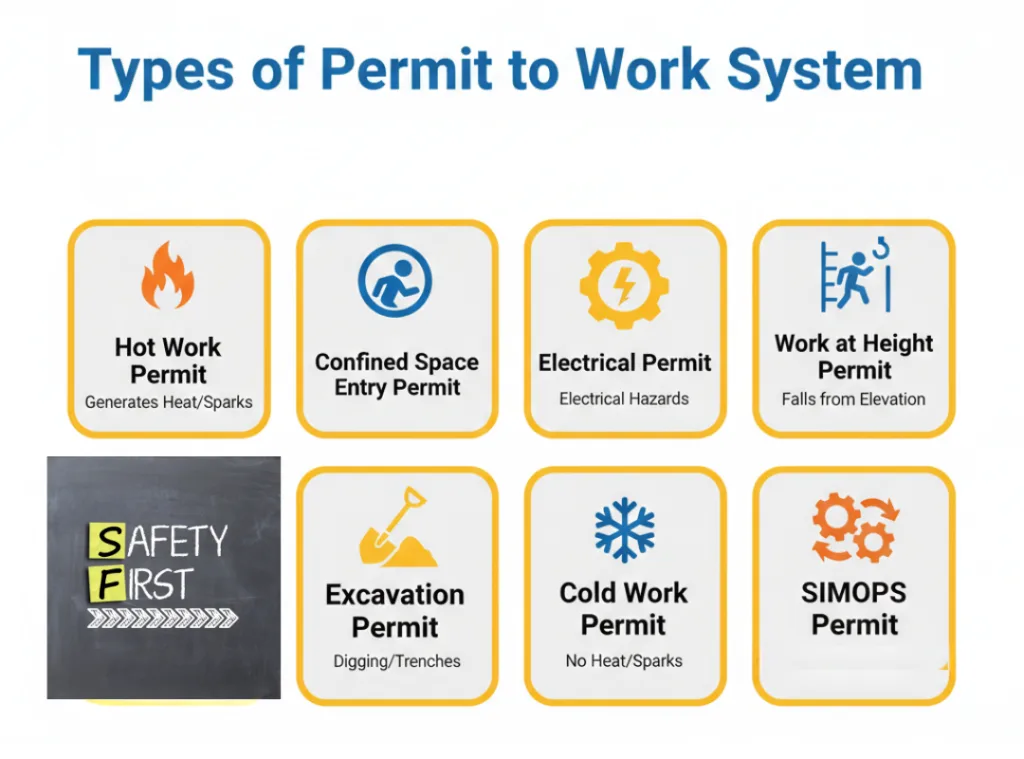
5. Excavation Permit
Used when digging trenches or excavating soil.
Controls include:
Utility detection
Shoring
Slope protection
Barricading
Gas detection (if required)
Excavation collapses are often fatal. Proper permit authorization helps prevent such incidents.
6. Cold Work Permit
Used for tasks that do not generate heat or sparks but still pose risk (mechanical repairs, valve replacements, etc.).
Even “low-risk” work requires structured hazard assessment.
7. SIMOPS Permit (Simultaneous Operations)
Used when multiple work activities occur in the same area and may interact.
For example:
Welding near scaffolding
Excavation near electrical lines
Maintenance during live plant operation
SIMOPS permits prevent one activity from increasing the risk of another.
How a Permit to Work System Actually Works
Let’s walk through the process.
Step 1: Identify the Job
If the task is hazardous or non-routine, it requires a permit.
Step 2: Risk Assessment
Hazards are identified.
Control measures are defined.
Emergency response is planned.
Step 3: Permit Issuance
A competent authority reviews and approves the permit.
No signature = no work.
Step 4: Toolbox Talk
The team reviews:
Hazards
Controls
Responsibilities
Emergency procedures
Step 5: Monitoring During Work
Supervisors ensure compliance with permit conditions.
Step 6: Permit Closure
Once work is completed safely, the permit is closed formally.
This documentation becomes part of audit and compliance records.
Common Mistakes in Permit to Work Implementation
Let’s be honest.
Some organizations treat permits like paperwork.
That’s dangerous.
Mistake 1: Copy-Paste Hazard Controls
Every job is different. Hazards must be job-specific.
Mistake 2: Untrained Permit Issuers
Competency is critical. Without training, the system fails.
Mistake 3: Poor Shift Handover
Permits must be reviewed during shift changes.
Mistake 4: No Field Verification
Permits written in office but not checked on site.
A permit to work system only works if it is actively monitored.
Benefits of a Strong Permit to Work System
When implemented correctly, PTW systems provide:
Reduced workplace accidents
Improved contractor control
Stronger compliance with ISO 45001
Better audit readiness
Clear accountability
Improved safety culture
In my experience, sites with disciplined permit systems have noticeably fewer near-miss incidents.
You can feel the difference.
Workers speak up.
Supervisors verify.
No one rushes blindly.
India and Global Perspective in 2026
In India, industries such as oil & gas, infrastructure, power plants, metro rail, and manufacturing increasingly rely on structured permit systems.
Globally, multinational corporations align PTW systems with:
OSHA standards (USA)
UK HSE guidelines
ISO 45001 requirements
Corporate governance audits
Digital permits are becoming common in Middle East projects and large Indian industrial zones.
But smaller construction sites still struggle with compliance.
And that’s where training becomes essential.
Frequently Asked Questions
The purpose of a permit to work system is to ensure hazardous tasks are properly assessed, controlled, authorized, and monitored before work begins, reducing the likelihood of accidents and unsafe conditions.
The main types of permit to work include hot work permit, confined space entry permit, electrical work permit, work at height permit, excavation permit, cold work permit, and SIMOPS permit.
Permit systems are required in many industrial sectors, particularly for high-risk work like confined space entry and maintenance activities. Companies implement PTW to meet regulatory and safety management requirements.
A competent and authorized person — typically a trained supervisor or safety officer — can issue a permit after reviewing hazards and control measures.
Most permits are valid for a specific shift or defined time period. If conditions change, the permit must be revalidated or reissued.
Final Thoughts: Why It All Comes Down to Discipline
After years in the field, here’s what matters most:
Identify the hazard properly.
Never rush permit approval.
Train people consistently.
Monitor actively.
A permit to work system is not about slowing down productivity. It’s about preventing irreversible mistakes.
Whether you’re working in Chennai, Mumbai, Dubai, or London, understanding the types of permit to work and applying them correctly can mean the difference between routine maintenance — and a major incident.
Safety isn’t complicated.
But it is disciplined.
If you’re an HSE professional or student, mastering permit to work systems is one of the most valuable skills you can develop in 2026 and beyond.