CPD Certification
CPD certification — short for Continuing Professional Development certification — is a structured process that verifies and documents the ongoing learning activities of a working professional. It works by recording skills gained after formal education and assigning measurable credit (CPD points or hours) to workshops, courses, conferences, and self-study. Unlike a degree, CPD accreditation is continuous: you earn it, maintain it, and renew it throughout your career.
You’ve probably seen it on a LinkedIn profile or a training brochure and wondered: is this actually worth my time? Or just another line on a CV that nobody checks?
Here’s the honest answer — it depends entirely on how seriously your industry treats it. In healthcare, engineering, law, and finance, CPD-accredited training isn’t optional. It’s the difference between keeping your licence and losing it. In other fields, CPD certification is the credibility signal that moves a CV from the ‘maybe’ pile to the ‘interview’ pile.
I’ve spoken to professionals across sectors who brushed off CPD for years, then scrambled to catch up when a promotion panel asked for evidence of ongoing learning. Don’t be that person. Let’s walk through everything you actually need to know.
Why CPD Certification Is More Urgent Than Ever in 2026
The shelf life of a professional skill has collapsed. According to the World Economic Forum’s Future of Jobs Report 2025, 44% of workers’ core skills will be disrupted within the next five years — the fastest rate of change ever recorded. That’s not a statistic you can afford to bookmark and forget.
What changed? Three things happened almost simultaneously: AI tools entered mainstream workplaces, remote-work norms shattered geographic hiring barriers, and employers started demanding proof of current competency rather than simply trusting that a degree from 2010 still applies in 2026.
CPD accredited courses fill that proof gap. When you complete a CPD-certified programme, you’re not just learning — you’re generating verifiable evidence that your skills are current. Most regulatory bodies, from the UK’s Chartered Institute of Personnel and Development (CIPD) to the General Medical Council, require members to log a minimum number of CPD hours annually.
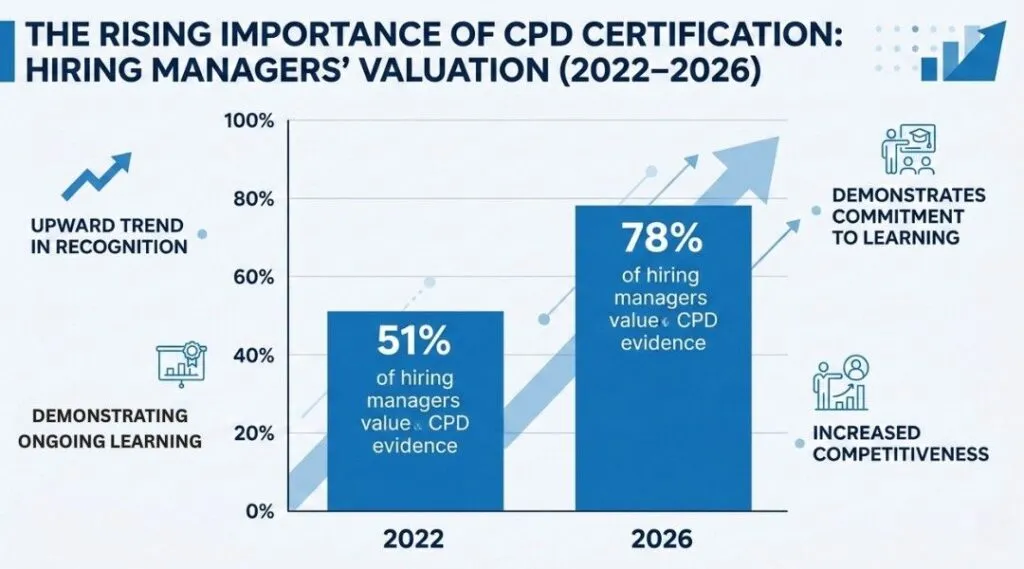
Here’s the kicker: even professionals in fields without mandatory CPD requirements are discovering that voluntary CPD certification separates them from peers who’ve been coasting. A 2025 survey by the CPD Certification Service found that 78% of hiring managers in the UK actively look for CPD evidence when shortlisting candidates for senior roles.
Three years ago, that number was 51%. The shift is real, and it’s accelerating.
How CPD Certification Actually Works: A 4-Stage Process
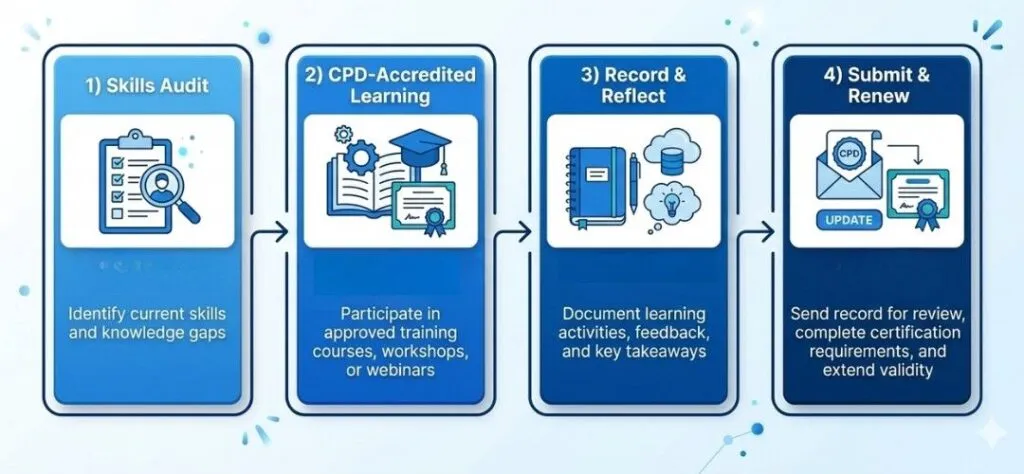
The phrase ‘continuing professional development training’ gets thrown around a lot, but most articles stop at the definition. Let’s go deeper.
Stage 1 — Identify Your Learning Gaps
Before booking any course, conduct a skills audit against your current role and where you want to be in two years. Ask: What do I do confidently? What do I avoid because I’m uncertain? What does my manager say I need to develop? Honest answers here save you money on irrelevant courses.
Stage 2 — Choose CPD-Accredited Activities
Not all learning counts equally. CPD activities fall into three categories:
- Formal/structured: CPD certified courses, workshops, webinars, accredited conferences
- Informal/self-directed: Reading industry journals, podcasts, peer learning, mentoring
- Work-based: Project debriefs, secondments, on-the-job training
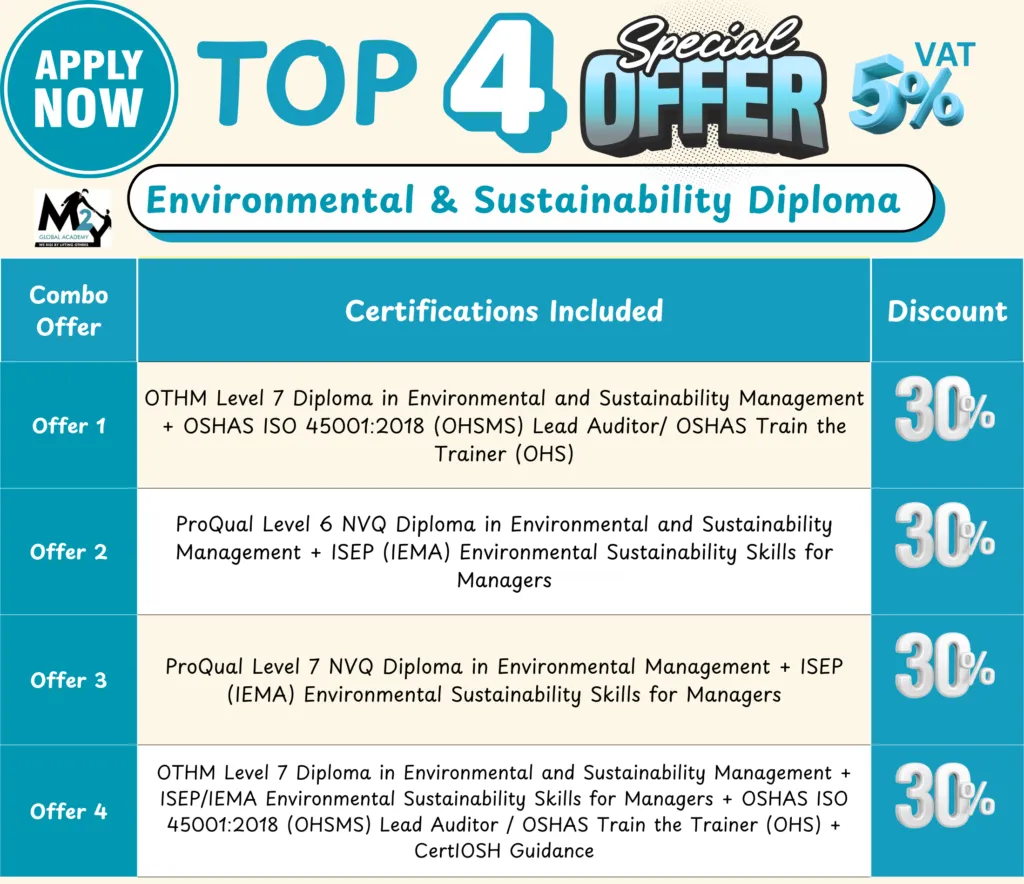
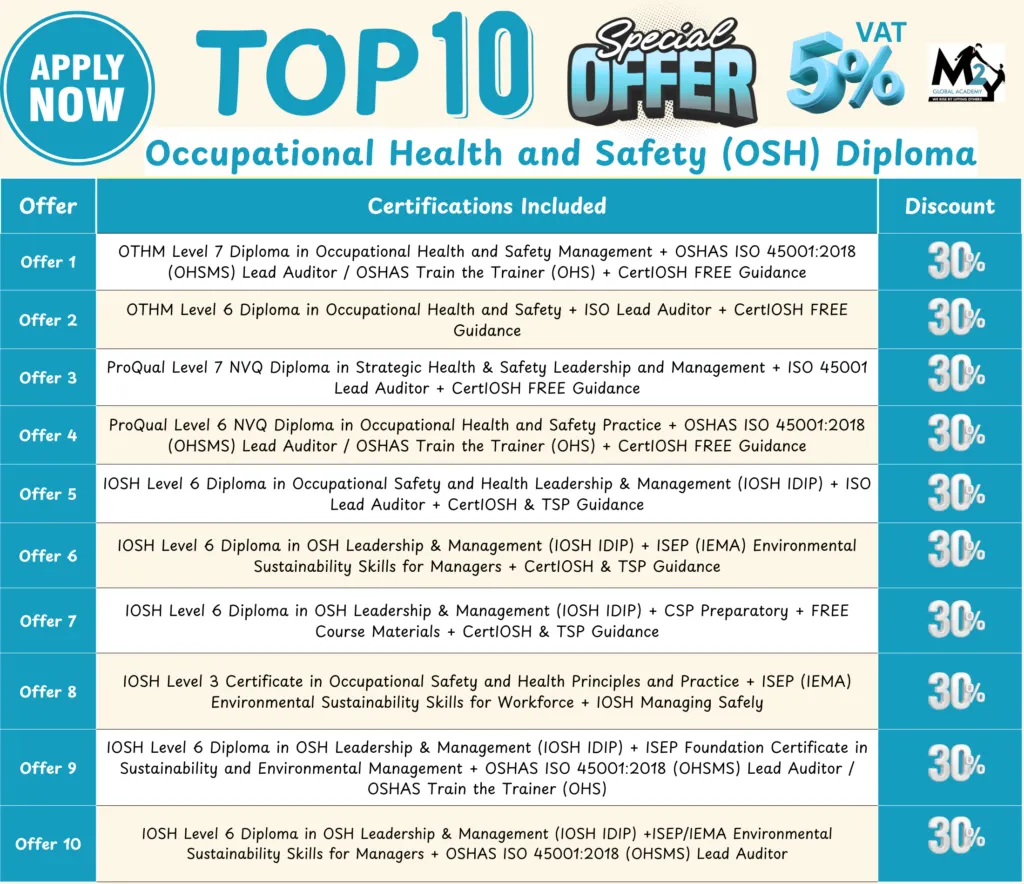
The important word there is ‘accredited.’ A CPD-accredited course has been independently reviewed by a recognised body — the CPD Certification Service, a professional association, or a regulatory authority — and confirmed to meet quality standards. M2Y Global Academy’s programmes are CPD-accredited, which means employers, regulators, and professional bodies recognise the hours you log there.
Stage 3 — Record and Reflect
This is where most professionals drop the ball. Completing a course isn’t the same as demonstrating CPD. You need a CPD log — a written record of: what you did, how many hours it took, what you learned, and crucially, how you applied it back at work. (Trust me, I learned this the hard way after a professional review where I’d done plenty of training but had zero documentation.)
Stage 4 — Submit for Review or Renewal
Depending on your professional body, you’ll either self-certify your CPD record annually or submit it for formal review. Some professions — nursing and architecture are good examples — have mandatory audits. Others run on an honour system. Either way, your CPD log is your evidence.
CPD Certified vs CPD Accredited: Are They the Same Thing?
This is the question almost every comparison article skips. And the confusion is understandable — the terms get used interchangeably, but there’s a meaningful distinction worth knowing.
CPD certified typically refers to an individual professional achieving a CPD requirement — you’ve logged your hours, completed your learning, and your record has been certified by a body.
CPD accredited refers to a course or training provider whose programme has been reviewed and approved to deliver CPD value. So M2Y Global Academy offers CPD accredited courses; you, as a participant, earn CPD certification by completing them.
Why does this matter? Because when you’re searching for continuing professional development training, you want to verify both: that the provider is accredited and that your completion generates a certificate you can log. A course that hands you a ‘certificate of attendance’ but hasn’t been reviewed by any professional body won’t count toward regulated CPD requirements.
CPD Certified vs CPD Accredited — Quick Reference
Term | Applies To | Example |
CPD Accredited | Course / Provider | M2Y Global Academy programme reviewed by CPD body |
CPD Certified | Individual Professional | You, after completing 30 CPD hours and submitting your log |
Certificate of Attendance | Neither (usually) | Proof you showed up — not necessarily recognised |
What the Experts Say
“Continuing professional development is not a bureaucratic checkbox — it is the mechanism by which a profession maintains its collective intelligence. Professionals who treat CPD as a compliance exercise miss the point entirely. The evidence consistently shows that reflective, purposeful CPD correlates with better outcomes: for the professional, their employer, and their clients.” — Prof. Sandra Dixon, Professor of Professional Education, University of Leeds, speaking at the 2025 National CPD Summit
Prof. Dixon’s view is consistent with data from the CPD Certification Service, which reports that 92% of professionals who engage in structured CPD (vs informal-only learning) report greater job confidence and measurable skill improvement within 12 months.
What CPD Certification Actually Does for Your Career (With Real Numbers)
Let’s make this tangible. Here’s what the research and real case studies say.
Salary uplift is documented. A 2025 study by the Chartered Management Institute (CMI) found that managers who actively maintained CPD portfolios earned an average of 12% more than peers who didn’t — across comparable roles, sectors, and experience levels.
Consider what that means practically: on a £40,000 salary, that’s £4,800 per year. The cost of most CPD accredited courses? Between £200 and £1,500. The return on investment is not subtle.
Promotions go to the documented. Priya Mehta, a healthcare administrator in Manchester who completed a CPD-certified leadership programme in 2024, told me: ‘I’d been in the same band for three years. Six months after finishing the programme and adding it to my appraisal evidence, I was shortlisted for a Band 7 role. The panel specifically mentioned evidence of ongoing development.’ That’s not coincidence — that’s CPD doing exactly what it’s designed to do.
However — and this is the part most glossy CPD brochures skip — CPD certification won’t rescue a fundamentally weak application. It’s a multiplier, not a magic fix. If you’re in the wrong role, no amount of CPD points will substitute for addressing the root mismatch. Your mileage may vary.
Who benefits most:
- Mid-career professionals seeking promotion in regulated industries
- Career changers needing credibility in a new field
- Freelancers and consultants who need verifiable expertise
- Employees in sectors with mandatory CPD requirements (healthcare, legal, engineering, finance)
CPD Certification FAQs — Answers to What People Actually Ask
CPD stands for Continuing Professional Development. In education, it refers to the structured learning teachers undertake after qualifying to improve classroom practice, subject knowledge, and leadership skills. In broader professional contexts, CPD full form in education and industry is identical — the ongoing commitment to skill development throughout a working career.
It depends entirely on your professional body. Solicitors in England and Wales must log 16 CPD hours annually. Nurses registered with the NMC need 35 hours over three years. Accountants with ICAEW require 120 hours over three years. If your profession has no mandatory requirement, most CPD advisors recommend a minimum of 20–30 hours per year as a credibility benchmark.
Yes, provided they're CPD accredited by a recognised organisation. The pandemic permanently normalised online CPD, and virtually all professional bodies now accept it. The key question isn't whether it's online but whether the provider has been reviewed and approved. M2Y Global Academy's online continuing professional development training programmes carry full CPD accreditation.
Usually yes, as informal/self-directed CPD — but with lower weighting than formal accredited activities. Most professional bodies allow up to 30–50% of your CPD portfolio to come from informal sources. Always check your specific body's rules. And document everything: title, date, duration, and your reflection on what you learned.
A CPD certificate confirms you've completed a specific course or logged a set of activities. It's evidence of ongoing learning but doesn't carry the same weight as a formal qualification (degree, diploma, professional charter). Think of CPD as the ongoing maintenance that keeps a qualification current and credible, not a replacement for foundational credentials.
Start with your professional body's recommended provider list. Alternatively, search the CPD Certification Service registry at cpduk.co.uk. When evaluating providers, look for: clear accreditation statements (not just 'CPD aligned'), a course ID or approval number, and transparent information about CPD hours awarded. M2Y Global Academy lists all accreditation details directly on each course page.
CPD frameworks vary by country, but the core concept is globally recognised. The UK's CPD model is widely respected internationally. In the US, CPE (Continuing Professional Education) is the equivalent. In many GCC countries, UAE, and India, UK-accredited CPD carries significant weight — particularly for finance, healthcare, and management professionals.
In regulated professions, failure to meet CPD requirements can result in suspension or removal from a professional register. For nurses, engineers, and solicitors this isn't hypothetical, it's enforced. In non-regulated fields, the consequences are softer but real: diminishing credibility, missed promotions, and a widening skills gap that becomes harder to close each year you delay.
After years of watching professionals both embrace and ignore CPD, here’s what matters most:
First: CPD certification is the only way to prove your skills are current in a world where skills decay faster than any previous generation. A degree is a starting line. CPD is the race.
Second: Not all CPD is equal. CPD accredited courses from recognised providers — like those offered by M2Y Global Academy — generate documentation that professional bodies, employers, and regulators actually accept. Certificate-of-attendance PDF from an unreviewed webinar? That won’t cut it in a formal audit.
Third: The ROI is documented and substantial. A 12% salary premium and measurable promotion advantage aren’t marketing claims — they’re independently verified data points. The question isn’t whether CPD is worth it. It’s whether you can afford to skip it.
Whether you’re a teacher building your CPD full form in education portfolio, a nurse maintaining your NMC registration, or a manager looking to make a credible case for promotion — the next right move is starting your CPD log today.
Browse M2Y Global Academy’s CPD-accredited continuing professional development training programmes and start building the documented evidence your career deserves.