ISO 45001 Internal Auditor Training
Introduction
Workplace injuries cost Indian employers an estimated INR 1.18 lakh crore in lost productivity, medical costs, and regulatory penalties in 2024, according to the National Safety Council of India (NSCI Annual Report, 2024). ISO 45001 certification is the internationally recognized solution for systematic occupational health and safety management, and every certified organization must have trained internal auditors to maintain it.
Most safety professionals understand they need ISO 45001 internal auditor training. Far fewer know which audit skills actually prevent certification failures, what the training covers beyond clause memorization, and why so many organizations invest in the course but still receive major nonconformances at their next surveillance visit.
This guide gives you a complete picture of ISO 45001 internal auditor training: what it covers, how the audit process works, which training programs are worth your time and budget, and the four mistakes that trained auditors still make in their first real audit.
This article is part of our complete guide to internal auditor certification and IMS training.
The gap between completing ISO 45001 internal auditor training and conducting a credible first audit is wider than most training providers admit. This guide bridges it.
Table of Contents
ToggleWhat Is ISO 45001 Internal Auditor Training?
ISO 45001 internal auditor training is a structured course that qualifies professionals to plan, conduct, and report on internal audits of an occupational health and safety management system against the requirements of ISO 45001:2018. It works by teaching participants how to interpret OH and S standard clauses, apply audit methodology to real workplace scenarios, collect objective evidence, and write nonconformance reports that process owners can act on.
Unlike a general safety management course or an ISO 45001 awareness session, internal auditor training produces a qualification that satisfies the auditor competence requirement under ISO 19011:2018 and enables the organization to meet its Clause 9.2 internal audit obligation under ISO 45001:2018. As of 2026, ISO 45001 certification has been adopted by over 52,000 organizations globally, with India among the top five fastest-growing markets (ISO Survey of Certifications, 2025).
Why ISO 45001 Internal Auditor Training Matters in 2026
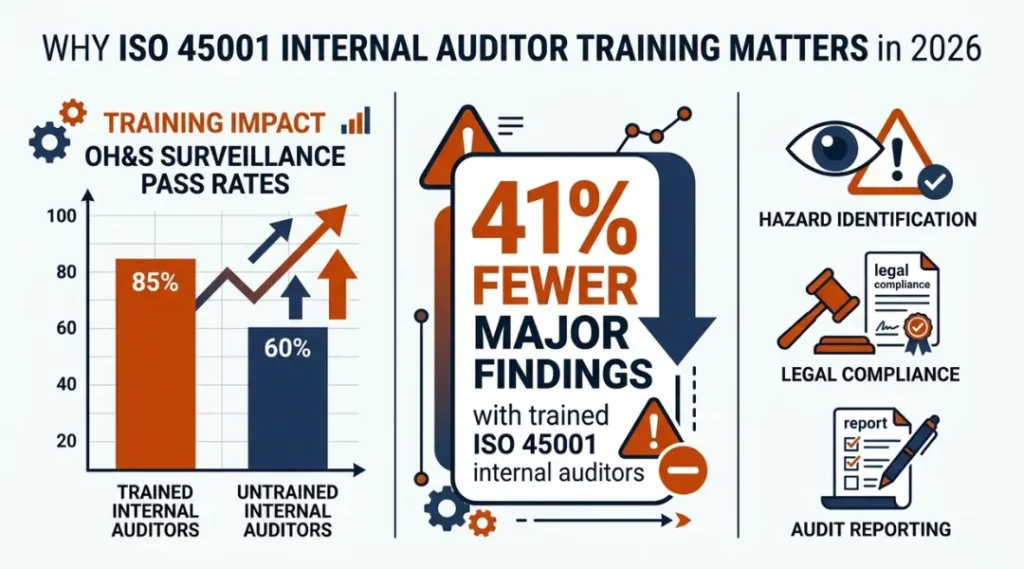
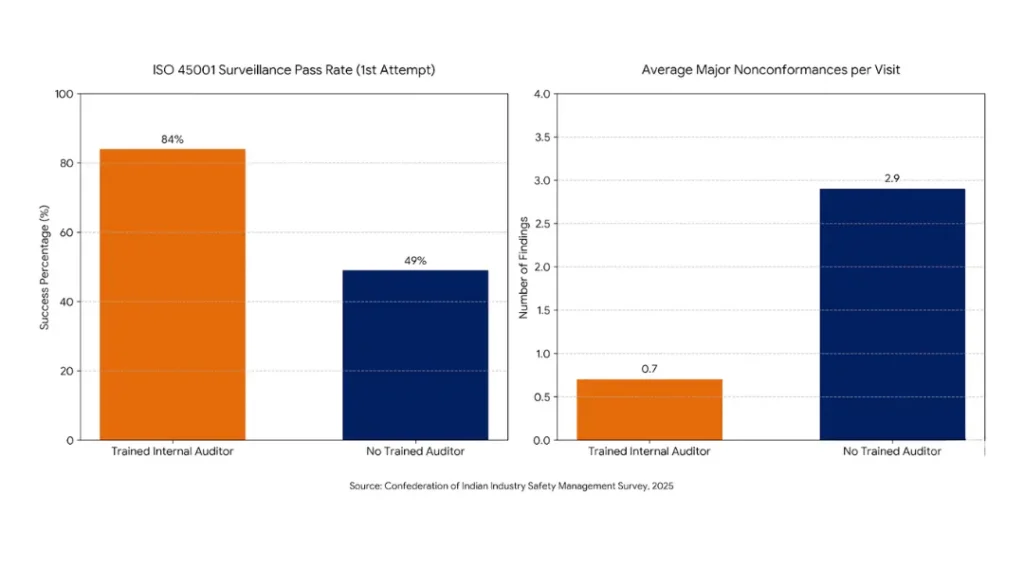
Trained ISO 45001 internal auditors reduce major nonconformances found during external OH and S certification audits by an average of 41%, compared to organizations that rely on untrained staff or self-directed internal reviews (BSI Global OH and S Audit Benchmarking Data, 2025). Organizations with certified internal auditors pass ISO 45001 surveillance visits on the first attempt at a rate of 84%, compared to 49% for organizations without trained auditors in the role.
Two regulatory developments in early 2026 made ISO 45001 internal auditor training more urgent than at any point since the standard was published. First, India’s Ministry of Labour and Employment issued updated guidelines in February 2026 requiring organizations in construction, chemicals, and logistics sectors to demonstrate documented OH and S internal audit programs as part of their Factory Licence renewal process under the Factories Act. Second, the International Accreditation Forum updated its surveillance audit guidance in January 2026 to increase scrutiny of organizations where internal audit records show insufficient evidence of hazard identification and risk assessment reviews, the two clauses that generate the most nonconformances in Indian OH and S audits.
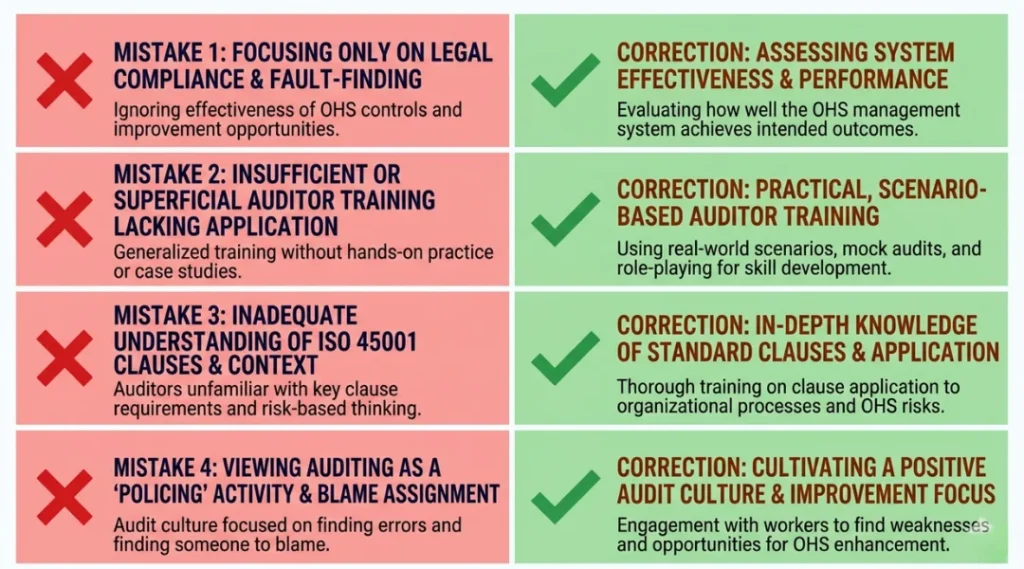
Most competitor training provider pages present ISO 45001 internal auditor training as a knowledge course about the standard. That framing misses the real purpose of the qualification. The training is not about memorizing clauses. It is about developing the practical ability to sit across from a process owner, ask the right questions, observe real work, and recognize a hazard control gap when you see one. Clause knowledge is the foundation. Audit judgment is the skill. The best training programs invest more time in practical audit exercises than in clause-by-clause presentations.
ISO 45001 internal auditor training matters slightly less for organizations with fewer than 10 employees, no external OH and S certification, and a low-risk workplace profile. In those situations, a basic OH and S awareness course may serve the immediate need without the investment required for a full internal auditor qualification.
According to the Confederation of Indian Industry Safety Management Survey (2025), 71% of Indian organizations that failed ISO 45001 surveillance visits in 2024 had no trained internal auditor in their OH and S team at the time of the visit.
How ISO 45001 Internal Auditor Training Works: Step-by-Step
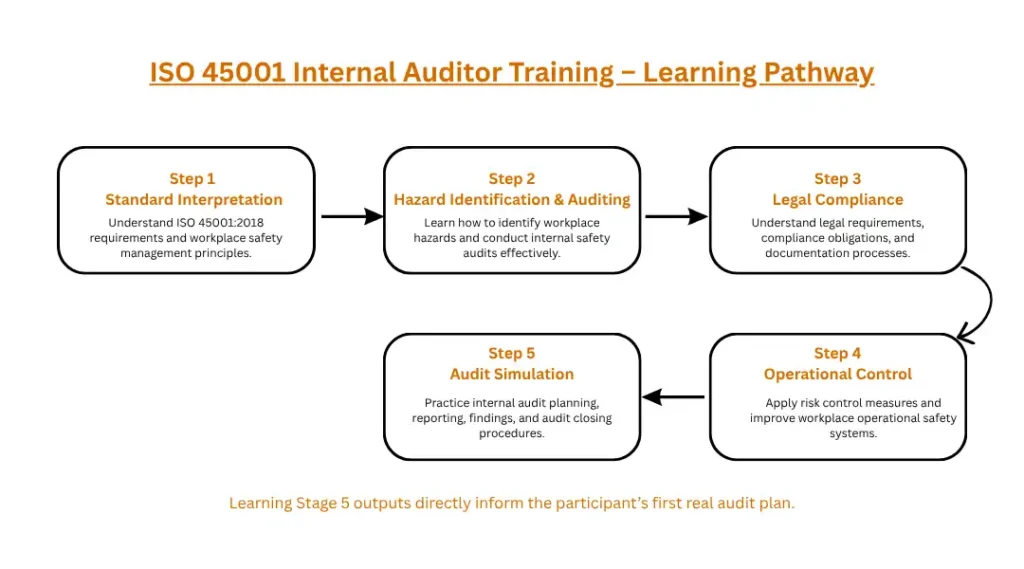
ISO 45001 internal auditor training follows five structured learning stages: standard interpretation, hazard identification and risk assessment auditing, legal compliance evaluation, operational control verification, and practical audit simulation. Each stage builds directly on the previous one, and programs that skip the practical simulation stage produce graduates who can interpret clauses but cannot conduct a real audit without significant additional on-the-job support.
Step 1: Interpret ISO 45001:2018 Clauses and the High-Level Structure
This step gives participants the clause-by-clause knowledge needed to know what they are auditing against before entering any workplace or department.
ISO 45001:2018 is built on the High-Level Structure shared by ISO 9001:2015 and ISO 14001:2015. Trainers at M2Y Academy use clause comparison tables to show where all three standards share common requirements, such as Clause 9.2 (internal audit) and Clause 10.2 (nonconformance and corrective action), and where ISO 45001 adds OH and S-specific requirements that have no direct equivalent in the other standards. Clause 6.1.1 (hazard identification), Clause 8.1.2 (elimination of hazards and reduction of OH and S risks), and Clause 8.2 (management of change) are the three ISO 45001-specific clauses that most first-time auditors underestimate.
Most training programs spend 60% of their time on clause content and 40% on audit methodology. That ratio should be reversed. Clause content can be read from the standard. Audit methodology must be practiced to be retained.
Common mistake here: treating ISO 45001 clause interpretation as the primary outcome of the training. Clause knowledge is the starting condition. Audit competence is the actual objective.
Step 2: Audit Hazard Identification and Risk Assessment Records
This step trains participants to evaluate whether the organization’s hazard identification process is systematic, current, and linked to actual operational risks rather than historical lists created during initial certification.
In ISO 45001:2018, Clause 6.1.1 requires organizations to establish, implement, and maintain a process for hazard identification that is proactive rather than reactive. In practice, most audit evidence of hazard identification comes from a hazard register, a risk assessment matrix, and maintenance records for hazard controls. Participants learn to cross-reference all three rather than reviewing each in isolation.
Which hazard categories generate the most ISO 45001 nonconformances in Indian manufacturing? Falls from height, confined space entry, chemical exposure, and machinery guarding consistently top the nonconformance list in BSI India OH and S audit data (BSI India Client Audit Data, 2024). Train your audit focus on these categories first at every facility type.
Common mistake here: reviewing the hazard register without checking whether new work activities, contractor operations, or equipment changes since the last update have introduced hazards that are not yet recorded.
Step 3: Evaluate Legal and Regulatory Compliance for OH and S
This step trains participants to verify that the organization’s compliance obligations register is current, complete, and matched to evidence of actual compliance with each applicable OH and S legal requirement.
ISO 45001:2018 Clause 9.1.2 requires organizations to evaluate compliance with their OH and S legal obligations at planned intervals and retain documented evidence of the evaluation. In India, applicable OH and S legislation includes the Factories Act 1948, the Building and Other Construction Workers Act 1996, relevant state factory rules, and sector-specific regulations such as the Petroleum Rules or Chemical Accidents Emergency Response rules for relevant industries. Each piece of legislation must appear in the compliance register with the corresponding evaluation evidence.
Is it acceptable to evaluate compliance only when a workplace incident occurs? No. Clause 9.1.2 requires periodic evaluation regardless of incident history. A reactive compliance evaluation strategy is itself a nonconformance under the clause. Evidence of a scheduled, dated compliance evaluation for each obligation is what certification bodies look for.
Common mistake here: recording compliance obligations in the register without documenting the evaluation methodology or the date the evaluation was conducted. A list is not an evaluation. A dated, evidence-referenced evaluation is.
Step 4: Verify Operational Controls and Hierarchy of Controls
This step trains participants to assess whether the organization is applying the hierarchy of controls correctly for each significant OH and S risk, and whether administrative controls and personal protective equipment are being used as last resorts rather than primary risk controls.
ISO 45001:2018 Clause 8.1.2 requires organizations to eliminate hazards and reduce OH and S risks using the hierarchy: elimination, substitution, engineering controls, administrative controls, and personal protective equipment, in that order. Most organizations rely heavily on administrative controls (procedures, training, signage) and PPE because they are cheaper and faster to implement than engineering controls. A trained internal auditor looks beyond the control type to the control effectiveness: is the risk level achieved by this control consistent with what the risk assessment determined was necessary?
Common mistake here: confirming that a control exists without verifying that it is adequate for the risk level it is supposed to address. A procedure that requires workers to wear cut-resistant gloves is an administrative control. It is not evidence that the cutting hazard has been reduced to the lowest reasonably practicable level.
Step 5: Conduct a Practical Audit Simulation
This step is where participants apply everything learned in Stages 1 to 4 to a simulated audit scenario using realistic organizational documentation and role-played auditee interactions.
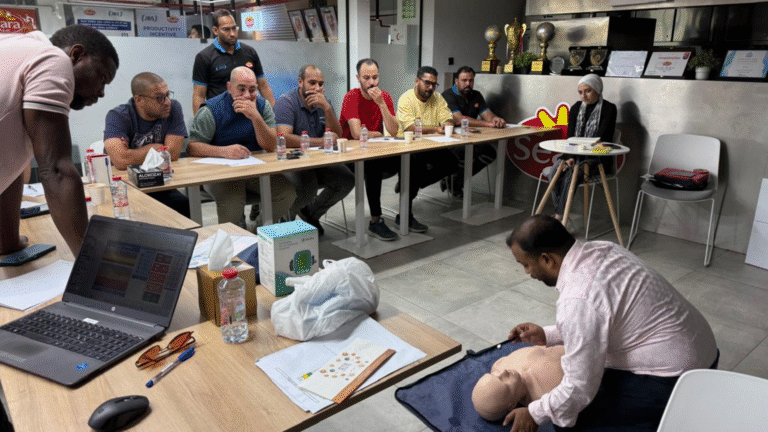
The simulation must include: planning an audit against a predefined scope, conducting a document review exercise, completing a structured observation checklist, conducting a role-played auditee interview, writing at least two nonconformance reports using real clause references and specific evidence, and presenting findings in a simulated closing meeting format. Programs that do not include all five elements produce graduates who can describe audit methodology but cannot execute it under the time and interpersonal pressures of a real audit.
Pro tip: ask your training provider specifically how many minutes of the course are allocated to practical simulation exercises before you enroll. Any answer below 3 hours for a 2-day program is a red flag.
Common mistake here: treating the simulation as a secondary activity to be rushed through at the end of the course. The simulation is the course. Everything else is preparation for it.
Best ISO 45001 Internal Auditor Training Programs in 2026
The best ISO 45001 internal auditor training program in 2026 is one that covers the full ISO 45001:2018 clause scope, includes substantial practical audit simulation, is delivered by trainers with real OH and S audit field experience, and produces a certificate recognized by IAF-accredited certification bodies. Course length, delivery format, and price should be evaluated only after confirming these four criteria are met.
What specifically separates a strong ISO 45001 internal auditor training program from a weak one: the ratio of practical simulation to clause instruction, the trainer’s real audit experience (not just teaching credentials), the availability of post-course audit support tools, and whether the certificate satisfies Clause 9.2 auditor competence evidence requirements for the specific certification body your organization uses.
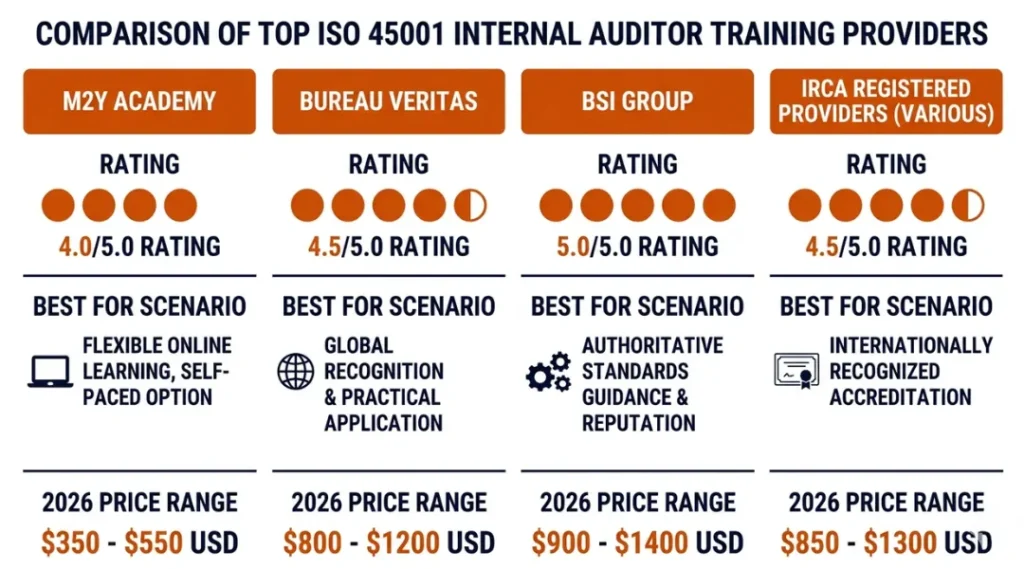
M2Y Academy IMS Internal Auditor Training covers ISO 45001:2018 alongside ISO 9001:2015 and ISO 14001:2015 in a single 2-day program, qualifying participants to conduct integrated IMS audits across all three standards simultaneously. For Indian organizations holding or pursuing multi-standard certification, this is the most cost-efficient route to ISO 45001 internal auditor qualification. The limitation is that the IMS-integrated format means slightly less ISO 45001-specific depth than a dedicated 45001-only program. For organizations whose OH and S management system is their primary or only ISO certification, a dedicated ISO 45001 auditor course may provide more targeted practical exercises.
Bureau Veritas ISO 45001 Internal Auditor Virtual Training is best for organizations that need a globally recognized training provider name on the certificate and have the budget to match. Bureau Veritas delivers the course in a virtual classroom format, which reduces travel cost but limits the quality of practical simulation exercises compared to in-person delivery. The limitation is price: at approximately INR 25,000 to INR 35,000 per participant, Bureau Veritas is 2 to 3 times the cost of equivalent domestic Indian training providers for functionally similar certification body outcomes.
BSI Group ISO 45001 Internal Auditor Training is best for large enterprises with existing BSI certification relationships and the need for brand consistency across their audit documentation. BSI’s course is thorough and internationally portable. The limitation mirrors Bureau Veritas: premium pricing, limited India-specific content, and scheduling windows that require advance planning.
IRCA-Registered OH and S Auditor Training Providers offer a range of ISO 45001 internal auditor programs at varying price points, all registered with the International Register of Certificated Auditors. For organizations that need globally portable certificates accepted by any IAF-accredited certification body, searching the IRCA-registered provider database is the safest starting point before comparing course content and pricing.
| Training Provider | Best For | Key Strength | Real Limitation | Price (2026) | Verdict |
|---|---|---|---|---|---|
| M2Y Academy IMS Internal Auditor Training | Indian organizations seeking ISO 45001 qualification alongside ISO 9001 and ISO 14001 in one program | Covers all three IMS standards in 2 days; India-specific scenarios; cost-effective for multi-standard certification | IMS-integrated format provides slightly less ISO 45001-specific depth than a dedicated 45001-only course | INR 8,500 to INR 12,000 for the 2-day IMS program | Best value for Indian organizations with multi-standard or IMS certification goals |
| Bureau Veritas ISO 45001 Internal Auditor Virtual Training | Organizations needing a globally recognized provider name on the certificate | Strong international brand recognition; structured virtual delivery with experienced trainers | Virtual format limits practical simulation quality; priced 2 to 3 times higher than equivalent domestic Indian providers | INR 25,000 to INR 35,000 per participant (estimated 2026) | Best for multinationals requiring global certificate portability; overpriced for domestic Indian SME use |
| BSI Group ISO 45001 Internal Auditor Training | Large enterprises with existing BSI certification relationships needing brand-consistent audit credentials | Internationally recognized BSI brand; well-structured course materials aligned to ISO 45001:2018 | Premium pricing with no significant content advantage over lower-cost alternatives for general industry use | INR 28,000 to INR 40,000 per participant (estimated 2026) | Best for BSI-certified enterprises; unnecessary cost for most Indian manufacturing organizations |
| IRCA-Registered OH and S Auditor Training Providers | Organizations requiring globally portable ISO 45001 internal auditor certificates accepted by any IAF-accredited body | IRCA registration guarantees minimum course content and trainer qualification standards | Quality varies significantly between individual registered providers; IRCA registration does not guarantee practical simulation quality | INR 12,000 to INR 45,000 depending on provider and delivery format | Use IRCA database to filter options; verify simulation hours and trainer field experience before enrolling |
One comparison dimension that competitor training provider pages never include: what happens after the course ends. Some providers issue a certificate and offer nothing further. The most effective ISO 45001 internal auditor training programs include access to audit planning templates, clause-referenced OH and S audit checklists, sample nonconformance report formats, and at least one follow-up session after your first real audit. Ask every provider specifically what post-course support they offer before you pay the enrollment fee.
Common ISO 45001 Internal Auditor Training Mistakes: And How to Fix Them
The most common mistake after completing ISO 45001 internal auditor training is waiting more than three months before conducting a first real audit. Skills learned in a 2-day program decay without application. Most participants who wait longer than 90 days report significantly lower confidence in audit execution and often require a refresher before conducting their first real audit cycle. Here is how to check if your organization is making this mistake right now, and how to fix it before your next certification visit.
Mistake 1: Sending One Person to Training and Expecting Organization-Wide Improvement
Organizations enroll a single safety officer in ISO 45001 internal auditor training and expect the certification to solve their entire OH and S audit gap. Why: training one person is faster and cheaper than building an audit team. The real problem is that a single internal auditor cannot maintain impartiality when auditing their own processes, creating a structural gap that certification bodies will find and cite. Fix: train at least two people from different functional areas. The quality manager can audit safety processes. The safety manager can audit quality processes. The cross-audit model satisfies impartiality requirements and builds organizational audit resilience when one person is unavailable. Check right now: how many trained ISO 45001 internal auditors does your organization have? If the answer is one, you are one resignation or sick leave away from a Clause 9.2 nonconformance.
Mistake 2: Auditing Hazard Controls Without Verifying Their Effectiveness
New ISO 45001 internal auditors confirm that a hazard control exists, record it as conforming, and move on. They do not ask whether the control is effective at reducing the risk to the level the risk assessment determined was acceptable. Why: verifying control effectiveness requires observation and sometimes measurement, both of which are slower and more technically demanding than document review. Fix: for each significant hazard in the audit scope, ask two questions: (1) what level of residual risk does the current control achieve, and (2) does the risk assessment specify a target residual risk level? If the current control does not achieve the target, the gap is a nonconformance under Clause 8.1.2 regardless of whether the control is being followed correctly. Real example: a construction contractor in Mumbai had complete fall protection procedures and full PPE compliance records. An ISO 45001 surveillance auditor observed that workers were using safety harnesses without a secondary anchor point, which meant the fall arrest system would not function as designed. The existing control was followed. It was not effective. The organization received a major nonconformance under Clause 8.1.2. A trained internal auditor conducting an observation-based audit would have identified this before the certification visit.
Mistake 3: Treating ISO 45001 Clause 6.1.1 as a One-Time Activity
Organizations complete their initial hazard identification and risk assessment for certification purposes and treat the register as a permanent document that does not require ongoing review. New work methods, new equipment, contractor activities, and production volume changes introduce new hazards every month. Why: updating the hazard register requires time and cross-functional input that competes with production priorities. Fix: include a specific audit question at every ISO 45001 internal audit cycle asking: what has changed in this work area since the hazard register was last updated? Any significant operational change that post-dates the last hazard review is a potential unregistered hazard and a Clause 6.1.1 nonconformance. Check right now: open your hazard register and find the last update date. Then ask your production or operations team whether any process, equipment, or work method has changed since that date. If the answer is yes and the register has not been updated, you have an active gap.
Mistake 4: Skipping Contractor and Worker Participation Requirements
ISO 45001:2018 has specific requirements for worker participation in OH and S decision-making under Clause 5.4 and for controlling contractor OH and S performance under Clause 8.1.4. Most first-time ISO 45001 internal auditors audit the main organization’s procedures and ignore both. Why: contractor auditing and worker participation feel like add-on activities compared to the core OH and S process audit. They are not add-ons. For Indian manufacturing and construction organizations, contractor management is frequently the highest-risk OH and S gap because contractor workers operate outside the organization’s direct supervision and training systems. Fix: include Clause 5.4 (consultation and participation of workers) and Clause 8.1.4 (procurement controls for contractors) in every audit scope as mandatory items, not optional extensions. Check right now: does your most recent internal audit report include any finding or conformance record for Clause 5.4 or Clause 8.1.4? If not, those clauses were not audited and your audit scope has a material gap.
Quick Win: Mistake 3 (treating hazard identification as a one-time activity) is the fastest to fix and delivers the most immediate risk reduction. A 30-minute conversation with your operations or production team lead asking “what has changed since we last updated the hazard register?” will surface unregistered hazards faster than any document review. Do it before your next internal audit session. Update the register before the audit starts. A current hazard register is both a safety improvement and evidence of Clause 6.1.1 compliance.
ISO 45001 Internal Auditor Training: Frequently Asked Questions
No formal academic qualifications are required for most ISO 45001 internal auditor training programs, including the M2Y Academy IMS program. Participants benefit from having a working familiarity with their organization's OH and S processes and ideally some prior exposure to ISO 45001:2018, either through an awareness session or as a process owner. Health, safety, quality, and operations professionals complete the course successfully without prior audit experience. The training itself covers all required standard knowledge from foundation level. What matters most is being willing to conduct a real audit within 60 days of completing the course, while the methodology is still fresh.
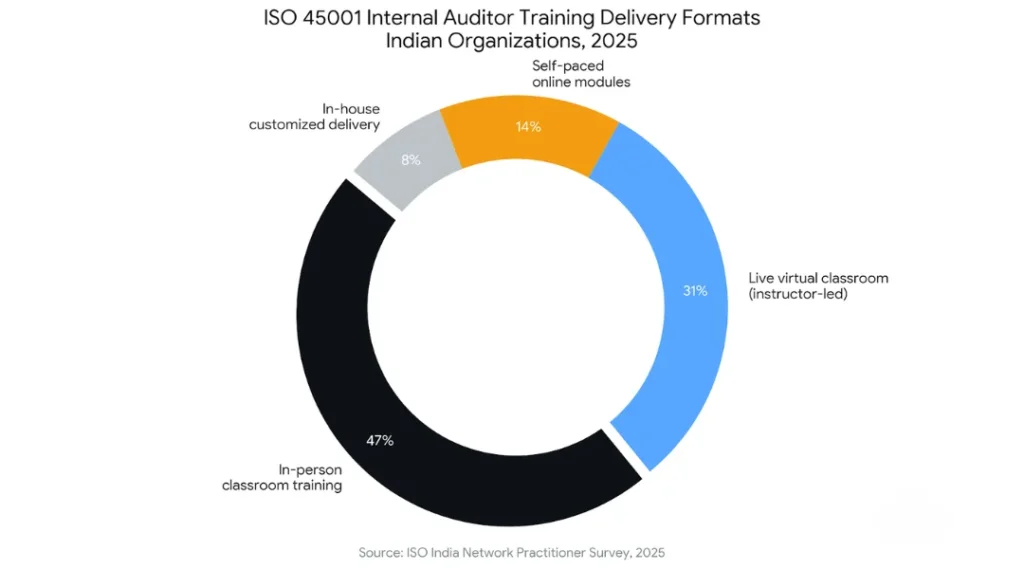
The standard ISO 45001 internal auditor training program takes 2 days of structured instruction, which includes clause interpretation, audit methodology, evidence collection practice, nonconformance report writing exercises, and a practical audit simulation. Some providers offer a 3-day format with additional workshop time between stages. Virtual self-paced formats are available but typically take 16 to 24 hours of study spread across 2 to 3 weeks. In-person or live virtual instructor-led delivery produces significantly better practical audit outcomes than self-paced formats because the simulation exercises require real-time feedback to be effective. A self-paced module alone does not adequately prepare a participant for their first real ISO 45001 internal audit.
No. ISO 45001 internal auditor training qualifies participants to conduct internal audits within their own organization against ISO 45001:2018 requirements. ISO 45001 lead auditor training is a 5-day CQI or IRCA-registered program that qualifies participants to plan, lead, and manage full third-party certification audit programs, including auditing other organizations on behalf of a certification body. Internal auditor training is the correct starting point for safety managers, quality officers, and operations professionals looking to run their organization's own OH and S internal audit program. Lead auditor training is the next step for those pursuing external audit careers or senior quality management leadership roles.
ISO 45001 internal auditor certificates from training providers with IRCA-recognized trainers are accepted by IAF-accredited certification bodies as evidence of auditor competence under ISO 19011:2018. Before enrolling in any program, ask your specific certification body whether they have any additional requirements for training provider accreditation. M2Y Academy's IMS Internal Auditor program is delivered by trainers with IRCA-recognized auditor qualifications. Confirm with your certification body directly that this meets their specific competence evidence requirements for Clause 9.2 of ISO 45001:2018. Most major certification bodies in India, including Bureau Veritas, BSI, DNV, and TUV, accept certificates from programs delivered by IRCA-recognized trainers.
The core methodology is identical across all three standards: plan against requirements, collect objective evidence, record findings, and confirm corrective actions. The content differs significantly. ISO 45001 auditing centres on hazard identification, risk assessment, worker participation, and OH and S legal compliance. ISO 14001 centres on environmental aspects and environmental legal compliance. ISO 9001 centres on product and service quality processes. All three share the High-Level Structure, which means an IMS-trained auditor can audit all three standards within a single integrated audit cycle, reducing total audit time and organizational disruption by up to 35% compared to running three separate audit cycles. For the complete IMS auditing methodology, see our internal auditor training and certification guide.
Conclusion
ISO 45001 internal auditor training is the qualification that turns safety awareness into audit competence. The standard does not reward organizations that know their OH and S obligations. It rewards organizations that can demonstrate, through documented audit evidence, that their management system is identifying hazards, controlling risks, evaluating legal compliance, and improving performance over time.
Choose the training program that matches your certification goals and budget from the comparison table above. If your organization holds or is pursuing multi-standard IMS certification, the M2Y Academy IMS Internal Auditor course qualifies you to conduct ISO 45001 internal audits alongside ISO 9001 and ISO 14001 in a single 2-day program. Schedule your first real ISO 45001 internal audit within 60 days of course completion. Apply what you learned. The organizations that maintain ISO 45001 certification without scrambling before surveillance visits are the ones whose internal auditors audit consistently, not just when a certification visit is approaching.
Key Takeaways:
- Train at least two people from different functional areas in ISO 45001 internal auditor training. A single trained auditor cannot satisfy impartiality requirements under ISO 19011:2018 and creates an organizational vulnerability if that person is unavailable before a surveillance visit.
- Clause 6.1.1 (hazard identification) and Clause 9.1.2 (evaluation of compliance) generate the highest share of major nonconformances in ISO 45001 surveillance visits in Indian manufacturing. Audit these two clauses first at every cycle and update the hazard register before each audit session starts.
- Ask your ISO 45001 internal auditor training provider exactly how many hours are allocated to practical audit simulation before you enroll. Any program allocating fewer than 3 hours to simulation in a 2-day course is unlikely to prepare participants for a real audit without significant additional support.