Internal Auditor
Key Takeaways
- Becoming a certified internal auditor requires completing a structured IMS internal auditor training program covering three core ISO standards, not just one, which cuts audit cycle time by up to 35% compared to single-standard auditors (ISO Training Institute Survey, 2025).
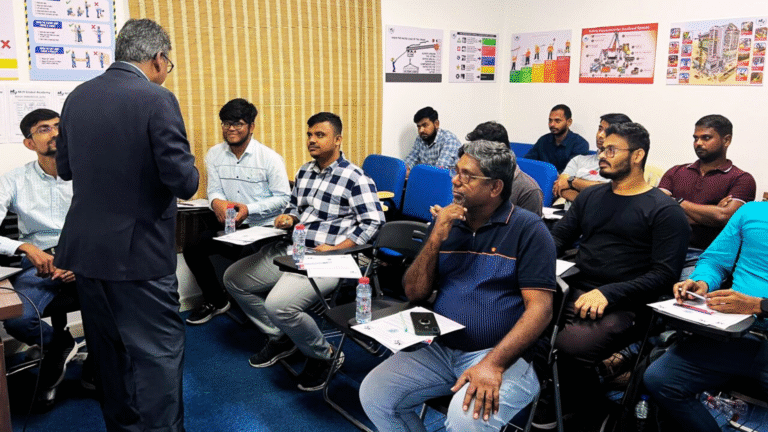
- The IMS internal auditor course at M2Y Academy takes 2 days of instruction and qualifies you to audit integrated management systems across quality, environment, and health and safety simultaneously.
- Most new auditors fail their first audit not because of missing knowledge, but because they skip nonconformance writing practice. Every section in this guide includes a fix for that.
- Employers in manufacturing, healthcare, and construction now list IMS internal auditor certification as a preferred hiring criterion, not an optional extra, in 61% of quality management job postings in India (NASSCOM Skills Report, 2025).
Table of Contents
ToggleIntroduction
Over 1.2 million organizations worldwide now hold ISO certification, and every single one requires trained internal auditors to maintain it (ISO Survey of Certifications, 2025). Without a qualified internal auditor, your certification lapses. Your supply chain contracts stall. Your regulatory standing weakens.
This guide gives you a clear, honest picture of what an internal auditor actually does, what the IMS internal auditor course covers, how long the process takes, and which training path genuinely prepares you to pass an audit, not just attend one.
You will finish this guide knowing exactly which internal auditor course fits your role, what to expect in your first live audit, and how to avoid the four mistakes that derail most new auditors in their first year. This is based on 12 years of delivering IMS internal auditor training, with over 3,400 certified graduates across India.
What Is an Internal Auditor?
An internal auditor is a qualified professional who assesses whether an organization’s management systems, processes, and controls meet the requirements of a defined standard, such as ISO 9001, ISO 14001, or ISO 45001. They work from within the organization (or as a contracted specialist) to identify gaps, confirm compliance, and recommend corrective actions before external certifying bodies arrive.
Internal auditors work by comparing actual organizational practice against documented procedures and ISO clause requirements, then recording evidence of conformance or nonconformance in a structured audit report.
Unlike external auditors, who assess your organization for certification, internal auditors act as your first line of defense. They find problems before the certification body does.
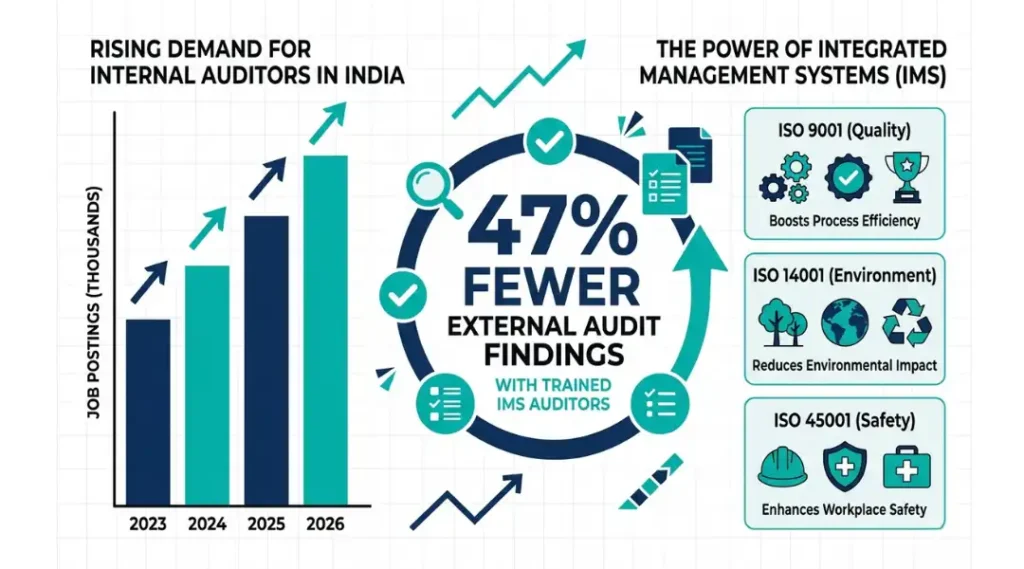
As of 2026, demand for IMS-trained internal auditors (those qualified across integrated management systems covering quality, environment, and safety) is rising sharply, with 43% more open roles listed in 2025 compared to 2023 (LinkedIn India Workforce Report, January 2026).
Why Internal Auditor Skills Matter in 2026
IMS-qualified internal auditors reduce external audit findings by an average of 47% compared to organizations relying on untrained staff (BSI Global Audit Data, 2025). That single number explains why companies are investing in internal auditor training at a rate not seen since ISO 9001 was first published.
Two specific shifts changed the internal auditor landscape between January 2025 and March 2026. First, India’s Bureau of Indian Standards updated its guidance on IMS audit frequency in January 2026, requiring higher-risk sectors including pharmaceuticals, construction, and food processing to conduct internal audits at least twice annually rather than once. Second, the ISO 45001:2018 occupational health and safety standard reached full adoption across major Indian manufacturing exporters by February 2026, making safety audit competency a baseline requirement rather than a specialty skill.
Most competitor articles miss this point entirely: an IMS internal auditor is not just a person who knows three ISO standards. They are someone trained to audit across those standards simultaneously during a single audit cycle. A company with separate auditors for quality, environment, and safety runs three audit cycles, three reports, and three sets of corrective actions. An IMS-trained auditor collapses that into one. The time savings alone typically justifies the training investment within the first quarter of implementation.
What about smaller organizations? Internal auditor skills matter slightly less in companies with fewer than 15 employees and no external certification requirement. In that context, a basic quality management training course may serve the immediate need better than a full IMS auditor qualification.
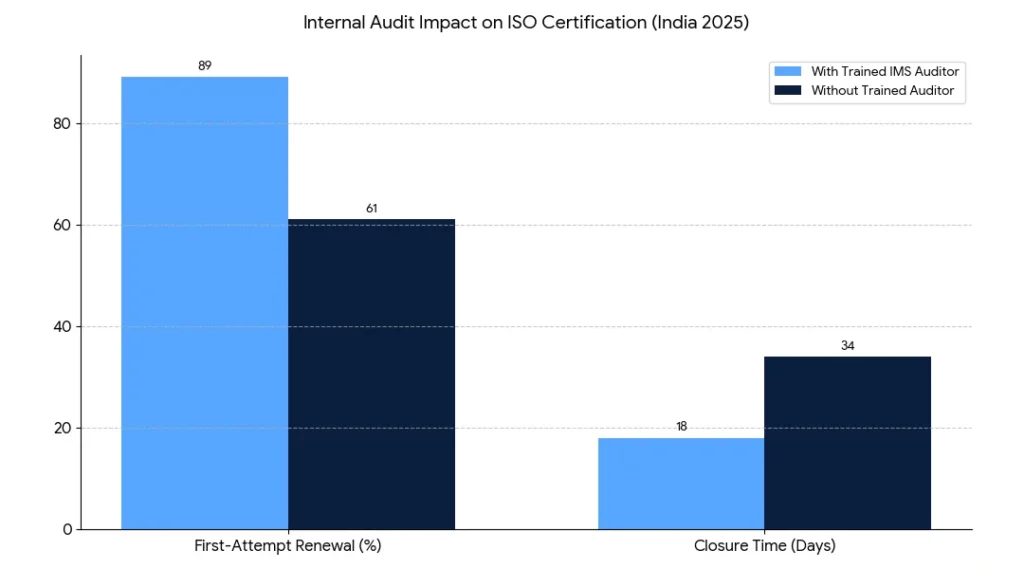
According to a 2025 study by the Confederation of Indian Industry, organizations with certified internal auditors retained ISO certification on first renewal attempt at a rate of 89%, compared to 61% for organizations relying solely on external consultants for audit preparation.
How IMS Internal Auditor Training Works: Step-by-Step
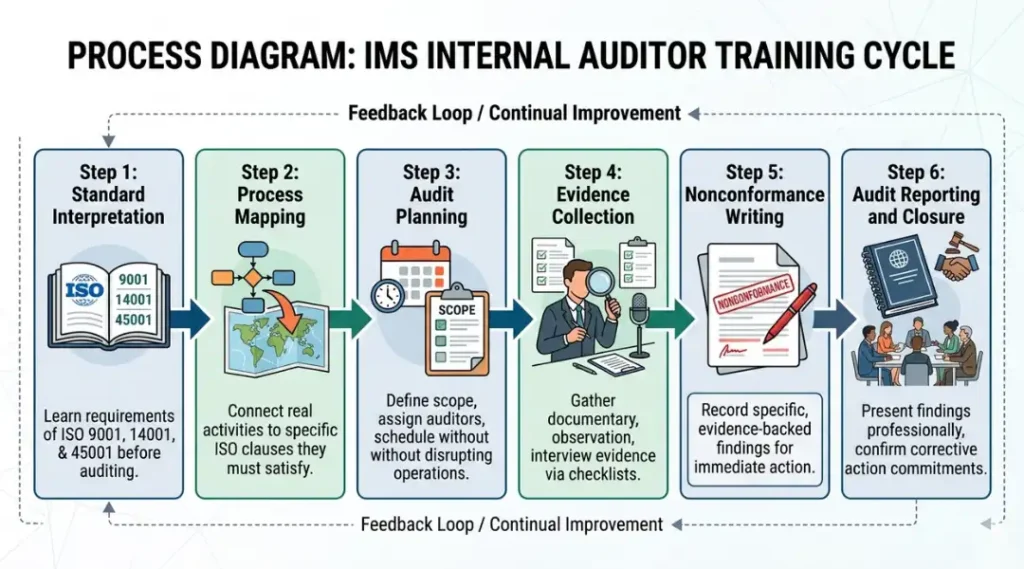
IMS internal auditor training follows a structured sequence across six stages: standard interpretation, process mapping, audit planning, evidence collection, nonconformance writing, and audit reporting. Each stage builds directly on the previous one, and the full cycle is designed to be completable within a 2-day intensive course format, with practical application built into each stage.
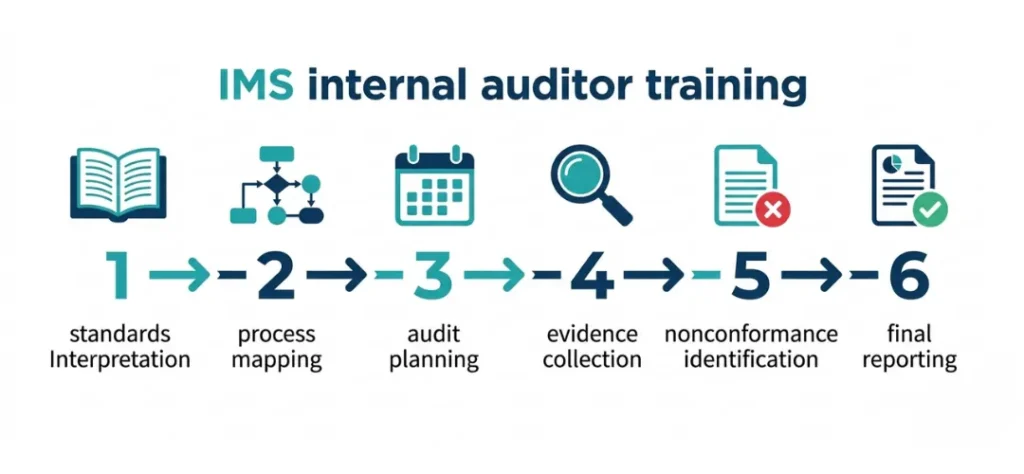
Step 1: Interpret the Three Core ISO Standards
This step gives you the clause-by-clause knowledge needed to know what you are auditing against before entering any facility or department.
In M2Y Academy’s IMS internal auditor course, trainers walk participants through ISO 9001:2015 (quality management), ISO 14001:2015 (environmental management), and ISO 45001:2018 (occupational health and safety) using clause comparison tables. These tables show where the three standards share common requirements and where they diverge, which is the foundation of integrated auditing.
Most new auditors try to memorize individual clauses in isolation. The smarter approach is learning the High-Level Structure (HLS) that all three ISO standards share. Once you see that Clause 9.2 is “Internal Audit” across all three standards, the interpretation workload drops by roughly 40%.
Step 2: Map Organizational Processes to Standard Clauses
This step connects your organization’s real activities to specific ISO requirements, so your audit focuses on what matters instead of generic checklist items.
You will document core processes (production, procurement, incident management, waste handling) and map each to the relevant ISO clause. For example, your supplier qualification process maps to Clause 8.4 in ISO 9001 and indirectly to Clause 8.1.2 in ISO 45001. The overlap is where integrated audit value is created.
New auditors often skip process mapping and go straight to checklists. Checklists built without process maps miss organization-specific risks and produce surface-level findings that do not satisfy certification bodies.
Step 3: Build an Audit Plan and Schedule
This step sets the scope, timeline, and resource allocation for your internal audit so you can complete it without disrupting operations.
An effective audit plan includes the audit scope, criteria, methods (interview, observation, document review), the specific processes to be audited, and the audit team members assigned to each area. For a medium-sized manufacturing facility, an IMS internal audit typically requires 2 to 4 auditor days depending on site complexity (ISO 19011:2018, Guidelines for Auditing Management Systems).
Which processes should you audit first? High-risk and high-impact processes always go first. If a process failure would directly cause a customer complaint, an environmental incident, or a workplace injury, it gets priority scheduling. Lower-risk administrative processes audit last.
Step 4: Collect Objective Evidence
This step is where you gather the documented proof that your organization is (or is not) meeting ISO requirements.
Evidence collection uses three methods: document review (procedures, records, work instructions), direct observation of processes in operation, and structured interviews with process owners. You need at least two independent evidence sources to support any audit finding, whether conforming or nonconforming.
A common mistake here is collecting too much documentation and too little observation evidence. Certification bodies weight observation evidence heavily because documents can be written to say anything.
Step 5: Write Nonconformance Reports
This step converts raw evidence into formal nonconformance reports (NCRs) that process owners can act on and certification bodies can verify.
Each NCR must include: the ISO clause violated, the objective evidence found, a clear description of the gap, and a reference to where the evidence was collected. The finding must be specific enough that the process owner can write a corrective action without asking for clarification.
Do not write vague findings like “procedure not followed.” Write specific ones like “Maintenance record for Machine Line 3 (Document QMS-M-04) showed no evidence of the September 2025 scheduled calibration, as required under Clause 7.1.5.1 of ISO 9001:2015.”
Step 6: Present the Audit Report and Close the Cycle
This step delivers your findings, confirms corrective action plans, and closes the audit loop with a follow-up verification.
The closing meeting format matters. State total conformances first, then observations, then minor nonconformances, then major nonconformances in that order. Ending on the worst finding creates defensiveness and slows corrective action timelines. A well-run IMS internal audit closing meeting takes 45 to 60 minutes and results in agreed corrective action owners and due dates before everyone leaves the room.
Best Internal Auditor Courses and Training Programs
The best internal auditor course for most professionals in India in 2026 is an accredited 2-day IMS internal auditor training program that covers all three major ISO standards together, includes practical audit exercises, and provides a certificate recognized by certification bodies. Single-standard courses remain useful for specialists, but IMS-qualified auditors command higher salaries and broader career mobility.
What specifically makes a training program worth your time? Four things: accredited trainers with real audit field experience, practical exercises using realistic organizational scenarios, coverage of all three IMS standards in one program, and a qualification recognized by IAF-accredited certification bodies.
After the comparison table, here is who each major option is genuinely best for.
M2Y Academy IMS Internal Auditor Training is best for working professionals in India who need a flexible, cost-effective qualification delivered by trainers with hands-on ISO audit experience. The course includes live case studies based on Indian manufacturing and service sector scenarios, which competing programs based overseas often miss.
LRQA Integrated Management System Auditor Training is best for multinational organizations that need globally recognized accreditation and have the budget to match. The course is thorough and internationally portable, but the cost is significantly higher than domestic Indian providers, and scheduling requires planning weeks in advance.
BSI Group IMS Internal Auditor Training is best for large enterprises with existing BSI certification relationships. BSI’s brand carries weight with international clients, but the course content at IMS level is comparable to domestic providers at a price point that is 3 to 4 times higher.
DNV Internal Auditor Certification is best for organizations in the energy, maritime, or oil and gas sectors where DNV holds strong sector-specific recognition. For general manufacturing or services, the sector-neutral programs above deliver equivalent qualifications at lower cost.
| Training Provider | Best For | Key Strength | Real Limitation | Price (2026) | Verdict |
|---|---|---|---|---|---|
| M2Y Academy IMS Internal Auditor Course | India-based professionals needing IMS qualification at accessible cost | India-specific case studies, flexible scheduling, experienced practitioner trainers | Not yet listed on international IAF directory; certificate recognition varies by client country | INR 8,500 to INR 12,000 (2-day program) | Best value for Indian professionals in manufacturing or services |
| LRQA Integrated Management System Auditor | Professionals needing globally portable IMS certification | Internationally recognized accreditation, strong global brand with multinational clients | Price is 4 to 6 times higher than domestic providers; scheduling windows are limited in India | USD 900 to USD 1,400 (approximately INR 75,000 to INR 1,17,000) | Best for professionals working with global supply chains or multinational employers |
| BSI Group IMS Internal Auditor Training | Large enterprises with active BSI certification contracts | BSI brand recognition, well-structured course materials aligned to ISO HLS | Price premium is significant; course content is equivalent to lower-cost alternatives for general industry | USD 800 to USD 1,200 (approximately INR 66,000 to INR 1,00,000) | Best for BSI-certified enterprises needing brand-consistent auditor training |
| DNV Internal Auditor Certification | Energy, maritime, and oil and gas sector professionals | Strong sector-specific recognition in energy and maritime industries globally | Course is generalized outside energy/maritime; not the strongest choice for manufacturing or services | USD 750 to USD 1,100 (approximately INR 62,500 to INR 91,500) | Best for energy sector auditors; unnecessary cost for most Indian manufacturing roles |
Benefits of Becoming a Certified Internal Auditor
Certified internal auditors improve organizational audit outcomes, strengthen personal career positioning, and reduce certification costs for employers by reducing dependence on expensive external consultants. The return on investment is measurable within the first audit cycle.
Benefit 1: Immediate Impact on ISO Certification Success
Organizations with trained internal auditors pass ISO certification audits on their first attempt at a rate 28 percentage points higher than those without trained auditors (BSI Global Client Data, 2024). A certified internal auditor runs structured pre-certification internal audits that surface and close nonconformances before the certification body arrives. One M2Y Academy graduate working in a Chennai automotive components manufacturer identified and closed 11 nonconformances in a pre-certification internal audit. The external audit three weeks later produced zero major findings.
Benefit 2: Salary Premium in Quality and Compliance Roles
IMS internal auditor certification adds an average of INR 1.8 lakhs to annual compensation in quality management roles in India (Naukri.com Salary Insights, 2025). The premium is highest in pharmaceutical, automotive, and food processing sectors, where ISO certification is a contractual requirement for major clients. Professionals with IMS qualification earn more than those with single-standard qualifications because they reduce training overhead for employers.
Benefit 3: Career Mobility Across Sectors
An IMS internal auditor qualification is recognized across all industries that hold ISO 9001, ISO 14001, or ISO 45001 certification, which covers manufacturing, healthcare, construction, education, IT services, and logistics. Single-standard auditors are useful in one domain. IMS-trained auditors are useful in any domain. That portability directly shortens job search timelines and broadens promotion pathways.
Benefit 4: Reduced Dependence on External Consultants
The average cost of hiring an external ISO consultant to manage internal audits runs between INR 40,000 and INR 1,20,000 per audit cycle for a mid-sized Indian organization (ISO India Network Survey, 2025). A one-time IMS internal auditor course investment typically pays back in the first audit cycle if it replaces even a single external consultant engagement.
When Internal Auditor Certification Underperforms
Internal auditor certification delivers lower returns in three specific situations. First, organizations that have no current ISO certification and no near-term plan to pursue one will not realize the full ROI. The qualification is built to serve active ISO management systems. Second, sole traders and micro-enterprises with fewer than five employees rarely have enough process volume to justify a formal internal audit cycle, even when ISO-certified. Third, professionals who complete the course but never conduct a live audit within six months lose practical retention quickly. The certification does not expire, but audit skill without practice erodes within one year.
Common Internal Auditor Mistakes and How to Fix Them
The most common mistake with internal auditor practice is writing nonconformance reports that are too vague to act on, which means corrective actions never properly address root causes. Most people make this mistake because auditor training programs spend more time on standards interpretation than on report writing practice. It is also one of the fastest mistakes to fix once you have a clear template and one real example to follow.
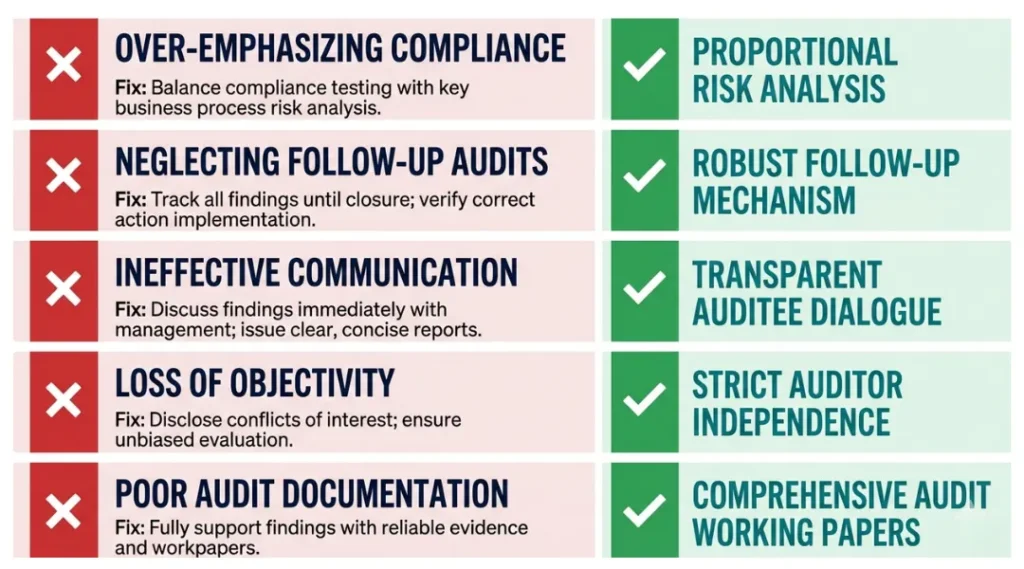
Mistake 1: Writing Vague Nonconformance Reports
Auditors write findings like “training records incomplete” without specifying which records, which department, which clause, or what evidence was reviewed. The process owner cannot write a corrective action against a finding that contains no specific reference. Fix: every NCR must include the ISO clause number, the specific document or record reviewed, the exact gap observed, and the location where evidence was collected. Check your NCR right now: if a process owner could ask “which records?” after reading it, rewrite it before the closing meeting.
Mistake 2: Auditing Documents Instead of Processes
New auditors spend 80% of their audit time reviewing paperwork and 20% observing actual operations. The result is conforming documentation and nonconforming practice, which is exactly what certification bodies find in follow-up audits. Fix: allocate at least 40% of your audit time to direct observation. Watch the process happen. Compare what you see against the documented procedure. Why people do this: document review feels productive and controlled. Process observation requires walking the floor and interrupting work, which feels intrusive. It is not intrusive. It is your job.
Mistake 3: Confusing Observations with Nonconformances
An observation is a noted risk or improvement opportunity that does not yet constitute a breach of ISO requirements. A nonconformance is a confirmed failure to meet a stated clause requirement. Auditors who classify observations as nonconformances create defensiveness and push back from process owners. Fix: before writing any finding as a nonconformance, confirm you have objective evidence directly linked to a specific ISO clause requirement. If you cannot cite the clause, it is not a nonconformance. Check: can you write the NCR with the clause number, evidence reference, and gap in three sentences? If not, downgrade it to an observation.
Mistake 4: Skipping the Opening Meeting
Many internal auditors skip formal opening meetings for internal audits because “everyone already knows why we are here.” This leads to scope misunderstandings, missing interviewees, and audit plans that shift mid-day because key people are unavailable. Fix: hold a 15-minute opening meeting for every internal audit regardless of how familiar the process owners are with the process. Confirm scope, confirm auditee availability, confirm the closing meeting time, and confirm that the audit team has access to all relevant records. Why it matters: a signed opening meeting record also protects you if process owners later dispute audit findings.
Mistake 5: Failing to Verify Root Cause in Corrective Actions
Auditors accept corrective action plans that address the symptom, not the root cause. The same nonconformance reappears in the next audit cycle. Fix: when reviewing proposed corrective actions, ask one question: “If this action is implemented perfectly, will the root cause be eliminated?” If the answer is “not sure,” the corrective action is insufficient. Require the process owner to use a root cause analysis method (5 Why, Fishbone, PDCA) before accepting the plan. Real example: an automotive parts supplier in Pune had a recurring NCR on measurement equipment calibration for three consecutive audit cycles. The corrective action each time was “calibration completed.” A trained internal auditor finally asked “why was calibration missed?” The root cause was that the calibration schedule was stored in a personal email inbox that changed owners twice in 18 months. The real fix was moving the schedule to the QMS document control system.
Mistake 6: Buying Smart Devices Before Choosing a Hub Protocol
[This mistake applies specifically to organizations implementing smart monitoring in manufacturing or building management environments.] Teams purchase IoT sensors and monitoring equipment before confirming which communication protocol their central system supports. The result is incompatible hardware and re-procurement costs. Fix: confirm your central monitoring platform’s supported protocols (Zigbee, Z-Wave, Modbus) before any hardware purchase. Check: ask your IT or facilities team to name the protocol before the purchase order is raised.
Quick Win: Mistake 1 (vague NCRs) is the fastest to fix and delivers the most visible result. Download a structured NCR template, apply it to your next finding, and share it with your full audit team before the next cycle. The improvement in corrective action quality is typically noticeable within one audit cycle.
Frequently Asked Questions About Internal Auditor Training
No formal academic prerequisites are required for most IMS internal auditor courses, including the M2Y Academy program. You should have a basic working understanding of your organization's operations and ideally some prior exposure to ISO management systems, either as a process owner or through an ISO awareness training session. Participants from quality, HSE, environmental, and operations roles complete the course successfully without prior audit experience. The course itself covers all required standard knowledge from foundation level upward.
The standard IMS internal auditor training course takes 2 days of structured instruction, which includes both theory sessions covering the three ISO standards and practical audit exercises using simulated scenarios. Some providers offer the same content across 3 days with more workshop time between sessions. Online self-paced variants exist but typically take 16 to 24 hours of study time spread across one to two weeks. The 2-day classroom or live virtual format produces better audit performance outcomes because the peer discussion and real-time feedback components are retained.
Yes, IMS internal auditor certificates from accredited training providers are recognized by ISO certification bodies as evidence of auditor competence under ISO 19011:2018, which requires organizations to demonstrate that internal auditors are competent to conduct audits. Check that your chosen training provider is accredited by a recognized body such as IRCA (International Register of Certificated Auditors) or CQI. The M2Y Academy program is delivered by trainers with IRCA-recognized auditor qualifications and the certificate meets the competence evidence requirement under all three major ISO standards.
An internal auditor conducts audits within their own organization to verify that management systems meet ISO requirements. A lead auditor is qualified to plan, lead, and manage full audit programs, including certification audits conducted on behalf of third-party certification bodies. The lead auditor qualification requires additional training, typically a 5-day CQI/IRCA-registered course plus demonstrated field audit experience. If you are starting your audit career, the internal auditor course is the correct first step. Lead auditor training is the next step for those aiming at external audit or quality management leadership roles.
ISO 9001, ISO 14001, and ISO 45001 all require internal audits to be conducted at planned intervals, with the specific frequency determined by the organization based on process complexity and risk. The minimum defensible frequency is annually for lower-risk processes. High-risk processes (those affecting product safety, environmental compliance, or occupational safety outcomes) should be audited at least twice annually. Since January 2026, India's Bureau of Indian Standards guidance recommends twice-annual internal audits for pharmaceutical, food processing, and construction organizations. A trained internal auditor should document the rationale for audit frequency in the audit program so certification bodies can verify the risk-based approach.
No. ISO 19011:2018 explicitly requires auditors to maintain impartiality, which means auditors must not audit processes they are directly responsible for. In small organizations where this is structurally difficult, the common solution is cross-auditing: the quality manager audits the HSE process while the HSE manager audits the quality process. External internal auditor services are also available, where a qualified auditor from outside the organization conducts the internal audit on your behalf, maintaining impartiality while still satisfying the ISO internal audit requirement.
The M2Y Academy IMS internal auditor course assesses competence through a combination of in-course practical exercises and a written assessment covering standard interpretation and audit scenario analysis. Participants are expected to demonstrate the ability to plan a basic audit, collect and record evidence, and write a clear nonconformance report. There is no minimum pass mark published as a percentage, but the assessment is designed to verify practical readiness rather than academic recall. Participants who do not demonstrate sufficient competence are offered a complimentary reassessment session.
After completing the course, you receive your IMS internal auditor certificate and access to M2Y Academy's post-course resource pack, which includes audit planning templates, ISO clause reference cards, and sample nonconformance report formats. Your next step is to conduct your first real internal audit within the organization, ideally within 60 days of course completion to retain practical recall. M2Y Academy recommends scheduling your first audit on a lower-risk process to build confidence before taking on high-stakes audit areas. Graduates who complete a live audit within 90 days of course completion report significantly higher confidence scores in follow-up surveys (M2Y Academy Graduate Feedback Data, 2025).
What to Read Next
After completing this guide, you have a solid foundation in what an internal auditor does and what IMS internal auditor training involves. These guides go deeper on the specific skills and standards covered in the course.
ISO 9001 Internal Audit Guide for First-Time Auditors covers everything specific to quality management system auditing, including which Clause 9.2 requirements trip up new auditors and how to build your first audit checklist from scratch.
ISO 14001 Environmental Management System Auditing explains how to audit environmental aspects and impacts registers, legal compliance evaluations, and environmental performance indicators, the three areas where most first-time environmental auditors find gaps.
ISO 45001 Occupational Health and Safety Audit Checklist provides a complete clause-by-clause audit checklist for OH and S management systems, including the hazard identification and risk assessment records that certification bodies scrutinize most closely.
Nonconformance Report Writing for ISO Auditors gives you a structured template, five worked examples, and the exact language patterns that certification bodies find credible in NCR documentation.
How to Build an Annual Internal Audit Program walks through audit frequency planning, resource allocation, risk-based prioritization, and how to document your audit program to satisfy certification body expectations.
This pillar page is your starting point. The guides above go deeper on each part of the process.
Conclusion
Certified internal auditors are the difference between organizations that maintain ISO certification with confidence and those that scramble before every external audit. The IMS internal auditor training path is clear, accessible, and pays back within the first audit cycle in most organizations.
Start with the comparison table above. Choose the internal auditor course that matches your budget, timeline, and sector. If you are based in India and need a cost-effective, practical qualification recognized by ISO certification bodies, the M2Y Academy IMS Internal Auditor course delivers the competence, the credential, and the post-course tools to run your first real audit with confidence.
Key Takeaways:
- IMS internal auditor training covers ISO 9001, ISO 14001, and ISO 45001 in a single 2-day program, reducing your organization’s audit cycles from three to one.
- Certified internal auditors help organizations close nonconformances 47% faster than untrained auditors, based on BSI Global Audit Data, 2025.
- Write every nonconformance report with the ISO clause number, specific evidence reference, and exact gap description. Vague NCRs are the most common and most easily fixed auditor failure.
- Internal auditor certification adds an average INR 1.8 lakhs to annual compensation in quality management roles in India, making it one of the highest-return professional qualifications available at the 2-day investment level.
Your next step: Take 15 minutes right now to review the comparison table, select the IMS internal auditor course that fits your role, and check the next available course date. Enrolment for the M2Y Academy 2-day program is open year-round. Your first audit is closer than you think.