Environmental Impact Assessment: A Comprehensive Guide to Understanding and Implementing EIA for Sustainable Development
Introduction
Environmental Impact Assessment (EIA) is a critical tool used worldwide to evaluate the potential environmental consequences of proposed projects before they are carried out. It plays a vital role in ensuring sustainable development by balancing economic growth with environmental protection. This comprehensive article delves into the definition, importance, objectives, process, types of impacts, global standards, benefits, challenges, and real-world examples of EIA. It is designed to provide students, professionals, and the general public with a clear, authoritative understanding of Environmental Impact Assessment.
What is Environmental Impact Assessment (EIA)?
Environmental Impact Assessment (EIA) is a systematic process used to identify, predict, evaluate, and mitigate the environmental effects of proposed projects or developments. It aims to ensure that decision-makers consider environmental impacts before approving projects, thereby promoting sustainable development and minimizing harm to the environment.
Importance and Purpose of Environmental Impact Assessment
The primary purpose of EIA is to integrate environmental considerations into the planning and decision-making process of projects. Its importance includes:
- Preventing environmental degradation by identifying potential adverse effects early.
- Promoting sustainable development by balancing economic, social, and environmental factors.
- Enhancing public participation and transparency in project planning.
- Ensuring compliance with environmental regulations and standards.
- Reducing project risks related to environmental liabilities and social conflicts.
Objectives, Scope, and Principles of EIA
Objectives
- To predict environmental impacts of proposed projects.
- To propose measures for impact mitigation.
- To inform decision-makers and the public.
- To promote environmentally sound and sustainable development.
Scope
EIA covers a wide range of environmental components including air, water, soil, biodiversity, socio-economic, and cultural aspects. It applies to various sectors such as infrastructure, industry, mining, agriculture, and urban development.
Principles
- Precautionary approach: Avoid harm when scientific certainty is lacking.
- Public participation: Engage stakeholders throughout the process.
- Transparency: Open access to information and findings.
- Sustainability: Promote long-term environmental health.
- Integration: Combine environmental, social, and economic factors.
The Step-by-Step EIA Process
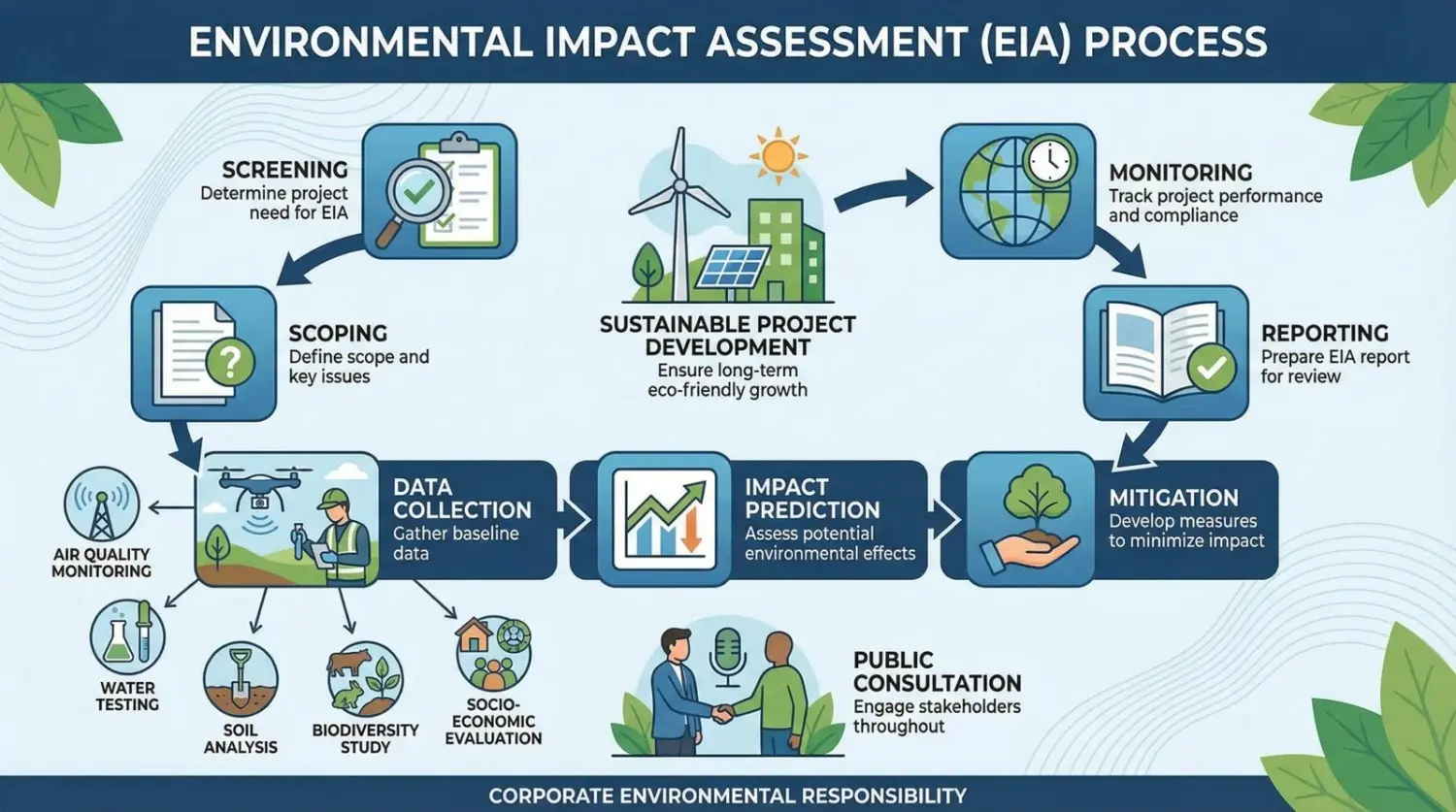
The EIA process is structured and methodical, typically involving the following stages:
1. Screening
Determines whether a project requires a full EIA based on its size, nature, and potential impacts.
2. Scoping
Identifies the key environmental issues and impacts to be studied, setting the boundaries and focus of the assessment.
3. Baseline Data Collection
Gathers data on the current environmental conditions to serve as a reference for impact prediction.
4. Impact Prediction and Evaluation
Analyzes potential positive and negative impacts on various environmental components.
5. Impact Mitigation
Develops strategies to avoid, reduce, or compensate for adverse impacts.
6. Reporting
Prepares the Environmental Impact Statement (EIS) or report documenting findings and recommendations.
7. Review
Authorities and stakeholders review the EIS for completeness, accuracy, and adequacy.
8. Decision-Making
Based on the EIA report, authorities approve, modify, or reject the project.
9. Monitoring and Compliance
Ensures that mitigation measures are implemented and evaluates actual impacts during project execution.
Types of Environmental Impacts
Environmental impacts assessed in EIA can be broadly categorized as follows:
| Impact Type | Description |
|---|---|
| Air Quality | Emissions of pollutants affecting atmospheric conditions and human health. |
| Water Quality | Effects on surface and groundwater resources, including contamination and usage changes. |
| Soil | Soil erosion, contamination, and changes in land use affecting fertility and stability. |
| Biodiversity | Impacts on flora, fauna, habitats, and ecosystem services. |
| Socio-economic | Effects on local communities, employment, health, and livelihoods. |
| Cultural | Impacts on heritage sites, traditions, and cultural landscapes. |
Global EIA Standards and Regulatory Frameworks
Environmental Impact Assessment is governed by various international guidelines and national regulations, including:
- The Espoo Convention (UNECE): International cooperation on EIA across borders.
- World Bank Environmental and Social Framework: Guidelines for projects financed by the World Bank.
- International Finance Corporation (IFC) Performance Standards: Environmental and social risk management.
- National Environmental Policies: Each country has its own EIA laws and regulations, e.g., the National Environmental Policy Act (NEPA) in the USA, Environmental Impact Assessment Notification in India, and the EU EIA Directive.
These frameworks ensure that EIAs meet minimum quality standards and promote best practices globally.
Benefits of Environmental Impact Assessment
For Governments
- Facilitates informed decision-making.
- Helps enforce environmental regulations.
- Reduces environmental conflicts and litigation.
- Promotes sustainable national development.
For Industries
- Identifies risks and reduces project delays.
- Enhances corporate social responsibility.
- Improves project design and sustainability.
- Builds community trust and acceptance.
For Communities
- Protects health and environment.
- Encourages public participation.
- Safeguards cultural and social values.
- Promotes equitable development benefits.
Challenges and Limitations of EIA
Despite its benefits, EIA faces several challenges:
- Data limitations: Incomplete or inaccurate baseline data.
- Technical complexity: Difficulty in predicting cumulative and long-term impacts.
- Political and economic pressures: Influence on objectivity and thoroughness.
- Public participation barriers: Limited access or awareness among stakeholders.
- Implementation gaps: Weak monitoring and enforcement of mitigation measures.
- Cost and time constraints: Lengthy and expensive processes may discourage thorough assessments.
Addressing these challenges is essential to enhance the effectiveness of EIA.
Real-World Examples and Case Studies
Case Study 1: The Three Gorges Dam, China
The EIA process for the Three Gorges Dam highlighted significant impacts on biodiversity, resettlement of communities, and water quality. Mitigation measures included habitat restoration and social compensation programs, though controversies remain regarding long-term effects.
Case Study 2: Belo Monte Hydroelectric Project, Brazil
This project’s EIA faced criticism for inadequate assessment of indigenous rights and biodiversity impacts. It underscored the importance of comprehensive scoping and genuine stakeholder engagement.
Case Study 3: London Heathrow Airport Expansion, UK
The EIA addressed air quality, noise pollution, and socio-economic impacts. Public consultations influenced project modifications, demonstrating the role of EIA in balancing development and environmental concerns.
Frequently Asked Questions (FAQs)
EIA assesses potential impacts before project approval, while EMP outlines how to manage and mitigate those impacts during project implementation.
No, EIA is mandatory only for projects likely to have significant environmental impacts, as determined during the screening phase.
The duration varies by project complexity and jurisdiction but typically ranges from several months to over a year.
Yes, public participation is a key principle, and comments can lead to project modifications or additional mitigation measures.
The project may be rejected, require redesign, or need additional mitigation to proceed.
By evaluating combined effects of the project with other existing or planned activities in the area.
Yes, including the Espoo Convention, World Bank guidelines, and IFC Performance Standards.
Monitoring ensures compliance with mitigation measures and assesses actual environmental impacts during project execution.
Absolutely, by integrating environmental considerations, EIA promotes sustainable project design and operation.
Typically, qualified environmental consultants conduct the EIA, but oversight is by regulatory authorities.
Key Takeaways
- Environmental Impact Assessment (EIA) is essential for sustainable development by evaluating and mitigating environmental impacts of projects.
- The EIA process includes screening, scoping, baseline data collection, impact prediction, mitigation, reporting, review, decision-making, and monitoring.
- EIA addresses diverse impacts including air, water, soil, biodiversity, socio-economic, and cultural effects.
- Global standards and regulations guide EIA implementation to ensure quality and consistency.
- EIA benefits governments, industries, and communities by promoting informed decisions, risk reduction, and environmental protection.
- Challenges such as data gaps, political pressures, and implementation issues must be addressed for effective EIA.
- Real-world case studies illustrate the practical application and importance of EIA in various sectors.
Summary and Concluding Insights
Environmental Impact Assessment is a cornerstone of modern environmental governance and sustainable development.
By systematically evaluating potential environmental consequences before project approval, EIA helps prevent environmental degradation, promotes social equity, and supports economic growth.
Its structured process, grounded in international standards and principles, ensures that environmental considerations are integrated into decision-making.
While challenges remain, continuous improvements in methodology, stakeholder engagement, and regulatory enforcement are enhancing the effectiveness of EIA worldwide.
For governments, industries, and communities alike, embracing robust Environmental Impact Assessment practices is vital to achieving a sustainable future where development and environmental stewardship go hand in hand.